// NATURE NEWS — SPAZIO & SCIENZA
Billion-dollar machine aims to set a fusion-energy record — and study nuclear weapons
Search author on:
PubMed
Google Scholar
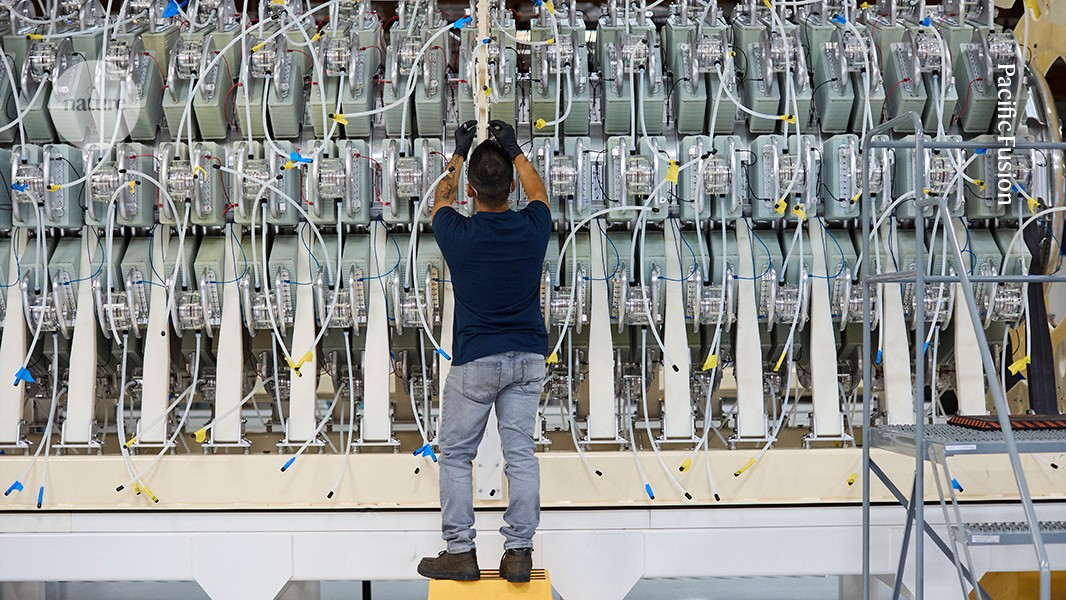
A worker assembles a huge impedance-matched Marx generator, which will be used to send powerful electrical pulses to the heart of Pacific Fusion’s machine. Credit: Pacific Fusion
A company has started to build a fusion machine that it hopes will be the first to generate more energy than it consumes, thanks to the use of immense pulses of electricity to squeeze capsules of hydrogen fuel. The billion-dollar facility, which will sit down the road from a major US nuclear-weapons laboratory, could also be used for research on the country’s ageing stockpile of nuclear warheads.
“It is going to be transformative for both fusion energy and defence applications,” says physicist Keith LeChien, who is chief technology officer and co-founder at the firm, Pacific Fusion.
How the world’s biggest laser smashed a nuclear-fusion record
Earlier this month, Nature visited the warehouse in Los Lunas, New Mexico, where Pacific Fusion is assembling key components of its machine. Beneath a wall-sized American flag, workers and a few industrial robots pieced together the first two of more than 150 truck-sized modules called impedance-matched Marx generators. These cylindrical banks of capacitors will be arranged around a central reaction chamber, a bit like the legs of a giant metal crab. The modules are intended to fire in parallel to generate an electrical pulse that packs a punch thousands of times greater than a lightning bolt, and direct it to a pea-sized fuel capsule at the machine’s centre.
The idea is that the enormous current will generate a powerful magnetic field around the fuel capsule, compressing it. With sufficient heating and pressure, the nuclei of the hydrogen isotopes will meld to form helium, releasing energy.
Pacific Fusion is ramping up production rapidly. The company’s goal is to achieve ‘net facility gain’ — the point at which the machine generates more energy than it uses — by the end of the decade. This benchmark is an important step towards the dream of a fusion power plant that supplies virtually limitless clean energy.
Several fusion researchers told Nature that this ‘pulsed power’ technique for initiating fusion is promising. But “there’s still a long ways to go”, says Michael Campbell, a fusion engineer at the University of California, San Diego.
Pacific Fusion, headquartered in Fremont, California, is one of dozens of fusion start-ups that have collectively raised more than US$14 billion of investment in the past five years. Pacific Fusion alone has raised more than $1 billion since it was founded in 2023, contingent on reaching certain technological milestones.