// NATURE NEWS — SPAZIO & SCIENZA
Daily briefing: How ‘thunderquakes’ probe underground geology
Search author on:
PubMed
Google Scholar
Hello Nature readers, would you like to get this Briefing in your inbox free every day? Sign up here.
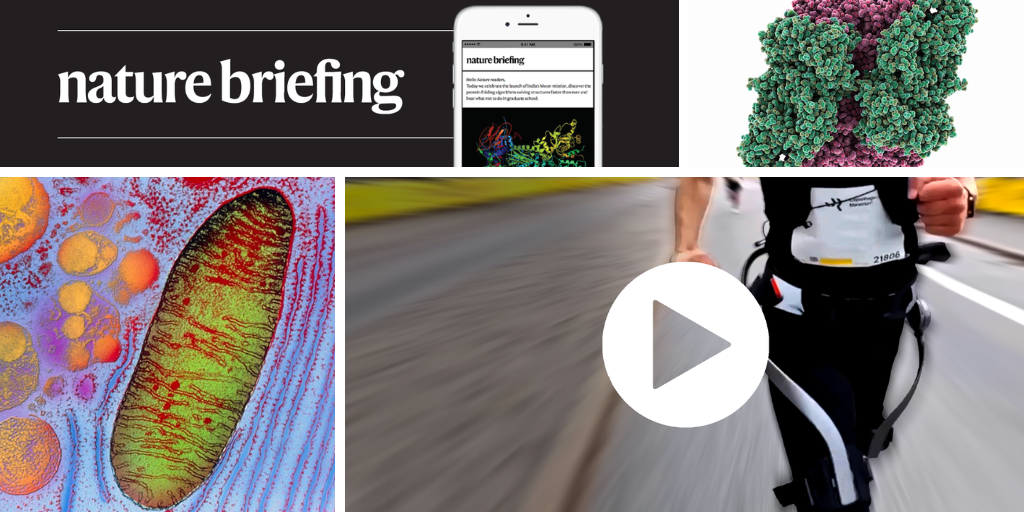
A microscope image of a mitochondrion, artificially coloured in green and red. The organelles were extracted for a retinal transplant from the person’s own leg muscles. Credit: K. R. Porter/SPL
Scientists have extracted mitochondria from a woman’s leg muscles and injected them into the vitreous fluid of her eyes in an attempt to treat severe blindness. The procedure caused no inflammation or side effects — but had a limited effect on restoring responses to light in the eyes, and did not restore the woman’s vision. The study shows that it was “relatively safe” to inject the person’s own mitochondria into the eyes, says mitochondria biologist Temurkhan Ayupov.
Reference: ResearchSquare preprint (not peer reviewed)
The proportion of papers published in December and archived in PubMed that showed signs of AI-assisted writing. (Nature | 9 min read)
More than 50 studies on cell ageing have apparently used the wrong antibody to identify a key protein in experiments, according to a science sleuth. The latest case comes two months after Sholto David, a UK-based independent molecular biologist, identified hundreds of studies with a similar error and three months after he and another researcher spotted problems with antibody-validation images in the catalogue of one of the world’s largest suppliers, Thermo Fisher Scientific.
Thunder generates acoustic waves that can help scientists probe the Earth for hidden geological structures, such as sinkholes. Researchers used a technique called distributed acoustic sensing, which detects tiny deformations in ordinary fibre-optic cable. A disused cable that snaked underneath their campus for more than 4 kilometres acted as more than 2,100 sensors, which the team used to show that it could one day be “possible to monitor the shallow subsurface continuously, using infrastructure that is already in the ground and seismic energy that is already coming from the sky”, write geoscientists Nolan Roth and Tieyuan Zhu.
Studies of the US labour market suggest that automation has played a crucial part in increasing inequality — and this dynamic is likely to intensify with the adoption of AI, argues economist Daron Acemoglu. Acemoglu has joined thousands of economists and AI researchers in signing We Must Act Now, a statement urging policymakers and technology leaders to steer AI towards complementing, rather than replacing, human labour. “What is at stake is not only shared prosperity, but also our democratic system,” he writes. “Societies cannot remain stable if large numbers of people are excluded from economic opportunity.”
Marine heatwaves and nutrient-rich agricultural pollution are creating an ecological paradox: wild kelp forests are dying off, but floating seaweeds and microalgal blooms are multiplying. Symptoms include sargassum smothering Atlantic shorelines — and releasing hazardous sulfide as it decays — and ‘dead zones’ caused by oxygen-depleting algal blooms. Local authorities are fighting back with seaweed-thwarting offshore barriers and trawlers, and kelp-forest restoration efforts are happening around the world.