// HACKER NEWS — CYBERSECURITY
Worst-case glacial lake flood scenarios in a transboundary Himalayan basin 2022
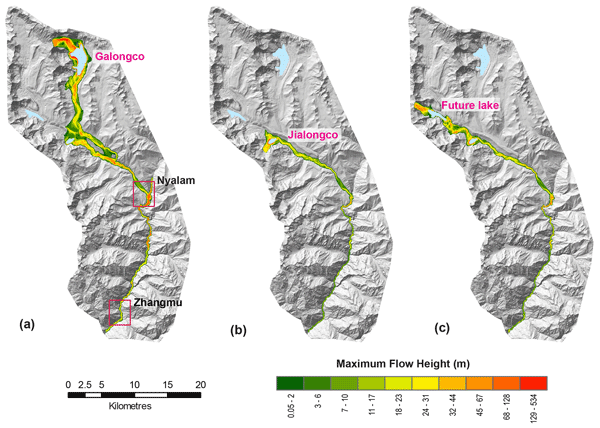
Glacial lake outburst floods (GLOFs) are a major concern throughout High Mountain Asia, where societal impacts can extend far downstream. This is
particularly true for transboundary Himalayan basins, where risks are expected to further increase as new lakes develop. Given the need for
anticipatory approaches to disaster risk reduction, this study aims to demonstrate how the threat from a future lake can be feasibly assessed
alongside that of worst-case scenarios from current lakes, as well as how this information is relevant for disaster risk management. We have focused on two previously identified dangerous lakes (Galongco and Jialongco), comparing the timing and magnitude of simulated worst-case outburst events from these lakes both in the Tibetan town of Nyalam and downstream at the border with Nepal. In addition, a future scenario has been assessed, whereby an avalanche-triggered GLOF was simulated for a potential large new lake forming upstream of Nyalam. Results show that large (>20×106 m3) rock and/or ice avalanches could generate GLOF discharges at the border with Nepal that are more than 15 times larger than what has been observed previously or anticipated based on more gradual breach simulations. For all assessed lakes, warning times in Nyalam would be only 5–11 min and 30 min at the border. Recent remedial measures undertaken to lower the water level at Jialongco would have little influence on downstream impacts resulting from a very large-magnitude GLOF, particularly in Nyalam where there has been significant development of infrastructure directly within the high-intensity flood zone. Based on these findings, a comprehensive approach to disaster risk management is called for, combining early warning systems with effective land use zoning and programmes to build local response capacities. Such approaches would address the current drivers of GLOF risk in the basin while remaining robust in the face of worst-case, catastrophic outburst events that become more likely under a warming climate.
Widespread retreat of glaciers has accelerated over recent decades in the Himalaya as in most other mountain regions worldwide as a consequence of
global warming (Bolch et al., 2019; King et al., 2019; Maurer et al., 2019; Zemp et al., 2019). A main consequence has been the rapid expansion and
new formation of glacial lakes (Gardelle et al., 2011; Nie et al., 2017; Shugar et al., 2020), which has large implications for both water resources
and hazards (Haeberli et al., 2016). When water is suddenly and catastrophically released, glacial lake outburst floods (GLOFs) can devastate lives
and livelihoods up to hundreds of kilometres downstream (Carrivick and Tweed, 2016; Lliboutry et al., 1977). This threat is most apparent in the
Himalaya, where glacial lakes have been increasing rapidly in both size and number (Chen et al., 2021; Wang et al., 2020; Zhang et al., 2015), and where
a frequency of 1.3 GLOFs per year has been recorded since the 1980s (Veh et al., 2019). The fact that GLOFs can extend across national boundaries
exacerbates the challenges for early warning or other risk reduction strategies, particularly in politically sensitive regions (Allen et al., 2019;
Khanal et al., 2015a).
Lakes can develop either underneath (subglacial), at the side of, in front of (proglacial), within (englacial), or on the surface of a glacier
(supraglacial), with the dam being composed of ice, moraine, or bedrock. In Asia, most scientific attention has focussed upon the hazard associated
with the catastrophic failure of moraine-dammed lakes and particularly those trapped behind proglacial moraines (e.g. Fujita et al., 2013; S. Wang et al., 2015). Such lakes can be very large, with volumes larger than 100×106 m3 and depths exceeding 200 m (Cook and Quincey, 2015), and are susceptible to a range of failure mechanisms owing to the low material strength of the dam structure (Clague and Evans, 2000; Korup and Tweed, 2007). In Asia, as elsewhere in