// NATURE NEWS — SPAZIO & SCIENZA
‘Robot Olympics’ reveal humanoids' rapid progress — but hurdles remain
Search author on:
PubMed
Google Scholar
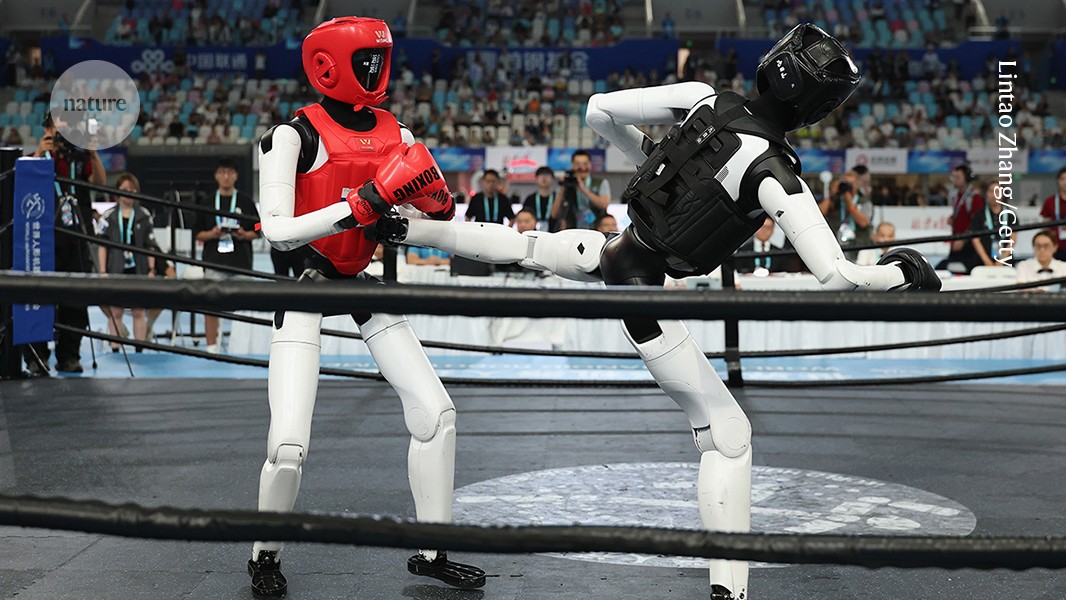
Robots compete during a combat event at the second World Humanoid Robot Games in Beijing.Credit: Lintao Zhang/Getty
A human-sized robot sprinted faster than any human has before. Another jumped more than 3 metres in the air to break a record. And a third faced off against a human Olympian during a table-tennis showcase match. These were scenes from the second annual World Humanoid Robot Games in Beijing, at which robots’ physical capabilities were put to the test.
Robots run this laboratory in Japan — and are changing how scientists work
The games highlighted how fast humanoid robots — which use artificial intelligence to learn, plan and execute real-world actions — are advancing. But they also demonstrated that the machines have a long way to go before they’ll be used by humans for practical tasks.
“If I ask you which is harder — folding laundry or doing a backflip — most people will say folding laundry is way easier,” says Karen Liu, a computer scientist at Stanford University in California. “But for humanoids, doing a task that we do in our daily lives is actually way harder than a backflip.”
This year’s games — which ran from 22 to 26 August and drew more than 600 competing teams, mainly from Chinese universities, research institutions and robotics companies — expanded the competition from sprints and jumps to include real-world challenges such as shelving books and making beds. In these ‘scenario-based events‘, which started before the athletics competitions, robots that completed tasks on their own were scored more highly than those that were remotely operated by humans.
The games “are not simply a competition, but an important real-world testing ground for embodied intelligence”, says Cheng Hao, chief executive of Booster Robotics in Beijing, which had nearly 300 robots at the games.
The event’s emphasis on practical tasks is crucial for developing useful robots, says Aya Durbin, who directs development of the Atlas humanoid robot at Boston Dynamics in Waltham, Massachusetts, which did not send robots to the games. “Humanoids won’t become a part of our everyday lives if they’re always ‘toys’. They need to be used to solve actual problems and make the world a better place.”
During the games, a robot from company X-Humanoid in Beijing took home a gold medal in the 100-metre sprint with a time of 8.64 seconds — almost one second faster than Olympian Usain Bolt’s record-breaking race in 2009. The same robot won the 100-metre sprint last year in 21.5 seconds, showing how quickly the technology is advancing. Another X-Humanoid bot jumped 3.4 metres vertically from a standing position at this year’s games, breaking a human record set in 1993, according to the state-run Chinese news outlet the Global Times.