// TOM'S HARDWARE US — HARDWARE & GADGET
Corsair RM1000e (2026) ThermalProtect power supply review: Temperature-sensing 12V-2x6 cable shuts the GPU down before a connector can melt
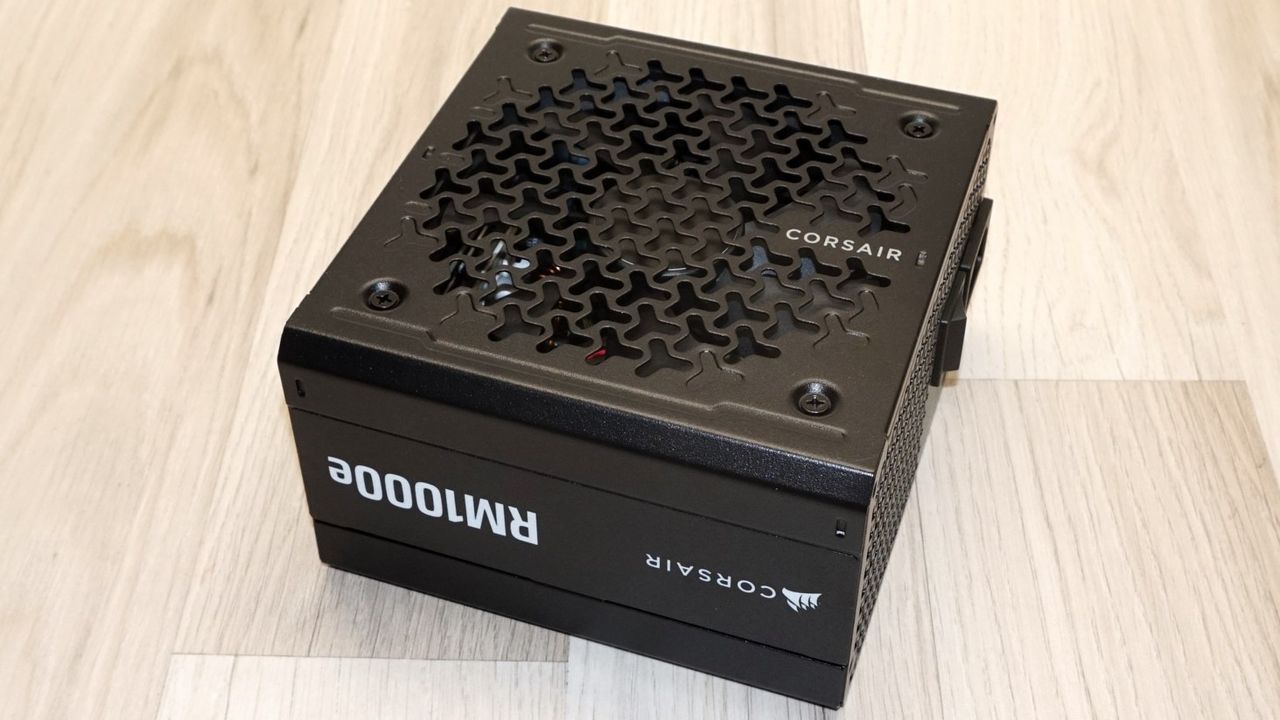
Built by HEC on the familiar RMe platform, the 2026 RM1000e is marketed with a Gold efficiency badge and adds Corsair's ThermalProtect 12V-2x6 cable, which cuts GPU power if the connector passes 65°C. Efficiency, ripple, and regulation are all strong; the fan stays off at 500W, and $180 buys seven years of cover.
Why you can trust Tom's Hardware
Our expert reviewers spend hours testing and comparing products and services so you can choose the best for you. Find out more about how we test.
Corsair has been selling power supplies for long enough that most builders have owned one without ever thinking about it. The company started in California in 1994 making memory modules, moved into cases and cooling, then peripherals, and picked up power supplies somewhere along the way. It has been nearly two decades since its first PSU launch, and today its PSU catalog runs from small SFX units up to 2000W flagships. Like almost every brand, Corsair commissions platforms from OEMs - CWT, Seasonic, Great Wall, and HEC have all had their turn - and the quality of any given Corsair unit has always been affected by it. Regardless, we should note that Corsair’s engineers typically alter the core platform significantly to improve its performance and reliability. What the company reliably adds on top of the hardware is distribution, a reputable RMA operation, and warranty terms that are a little better than the tier would suggest.
The RMe line is the mainstream series of Corsair’s huge lineup, sitting below the RMx and a longer way below the HXi and AXi units. It has been through several revisions since 2022. The 2026 version launched on the 18th of August and brings just one significant change, which is the 12V-2x6 cable. Every 2026 RMe unit now ships with a ThermalProtect 12V-2x6 cable, a 600W cable with a temperature sensor built into the comb near the graphics card end, providing hardware aimed at the melting-connector problem rather than a leaflet warning about it. Another noteworthy point is efficiency, with Corsair typically marketing their RMe series with a Gold badge and now seems to be claiming a Cybenetics Platinum rating, with the box carrying both the Platinum ETA badge and a LAMBDA A noise badge.
We take a closer look at the Corsair RM1000e (2026) ThermalProtect to ascertain whether it ranks among the best power supplies in the PSU market today. The RM1000e reviewed here is the larger of the two launch models, at $179.99 MSRP with a 7-year warranty and a 1000W single-rail 12V output rated for 50°C ambient.
The box is the yellow-and-black theme Corsair has used for years, with the modular panel photographed on the front and "with ThermalProtect" under the model name. The badge strip along the bottom is the interesting part: Cybenetics Platinum, Cybenetics LAMBDA A, ATX 3.1 with PCIe 5.1 and 12V-2x6, and an Nvidia 50 Series Ready sticker. There is no 80 PLUS logo anywhere on the box, which is deliberate rather than accidental, as Corsair had publicly announced that they would only be using Cybenetics for certifications a while ago.
Inside, the unit is sandwiched between protective packaging, cables bagged separately. The bundle is very thin, with just an AC cord, four mounting screws, a handful of zip ties, and a basic booklet. No Velcro straps, no combs, no tester. At $180, that reads as stingy.
The cables are all-black, individually sleeved and debossed rather than the flat ribbon type earlier RMe units used. You get a 610mm 24-pin, two 750mm EPS 4+4 leads, the 650mm ThermalProtect 12V-2x6, a 650mm 12V-2x6-to-dual-8-pin PCIe cable, two single 650mm 8-pin PCIe leads, a four-connector SATA cable and a mixed two-SATA/two-Molex cable, both 750mm. The 12V-2x6-to-dual-8-pin PCIe cable occupies the same PSU-side socket as the 12V-2x6 cable, so you can run the 12V-2x6 or four PCIe 8-pins, not both.
ThermalProtect is the reason this revision exists, and it lives in the cable rather than the power supply. A temperature sensor sits