// SPACE.COM — SPAZIO & SCIENZA
'What a glorious dawn launch': Why the Roman Space Telescope's picture-perfect liftoff beyond Earth is such a big deal
"We're just about to set foot off into the unknown."
When you purchase through links on our site, we may earn an affiliate commission. Here’s how it works.
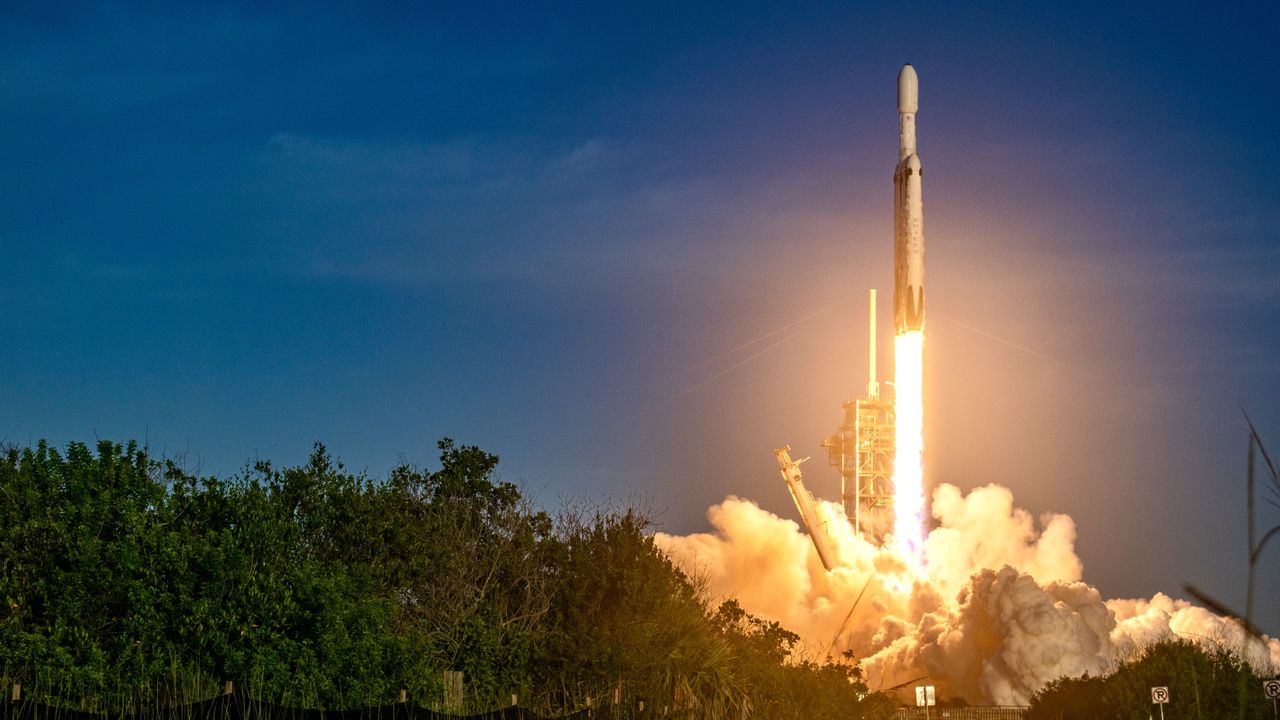
CAPE CANAVAREL, Fla. — It was a bright and sunny morning here in Florida when the Nancy Grace Roman Space Telescope lifted off planet Earth against a magical blue sky.
"What a glorious dawn launch," Jackie Townsend, the Roman Space Telescope's project manager, said during a post-launch press conference on Sunday (Aug. 30). "The ride was magnificent — it put us right where we wanted to be. All of the deployments went great."
Roman lifted off on a SpaceX Falcon Heavy rocket right on cue at 7:26 a.m. EDT (1126 GMT), beginning its journey to revolutionize the way we see the universe. It will be able to do this thanks to the two stars of its toolkit, the Wide Field Instrument (WFI) and the Coronagraph Instrument. The former is meant to image extremely wide sections of the cosmos to capture tons of fleeting phenomena that are hard to catch — things like supernovas, fast radio bursts and maybe even colliding neutron stars.
Its uniquely wide view will also help scientists decode the intricacies of dark matter and dark energy while perhaps clearing up some contradictions about our universe that scientists have been scratching their heads over for decades. What's the source of the puzzling "Hubble tension?" Why exactly is the universe expanding the way it is? Are we alone?
Meanwhile, the coronagraph will take direct images of exoplanets and bring us a gallery of "Pale Brown Dots" from beyond our solar system akin to the Voyager spacecraft's priceless "Pale Blue Dot" portrait of Earth.
Now that it has lifted off, the Roman Space Telescope will undergo a 90-day commissioning period while traveling to its station in space at the sun-Earth Lagrange Point 2, or L2. This is a gravitationally stable point in space on the side of Earth always opposite the sun; it's a popular location to send telescopes because the orientation allows spacecraft to remain safe from heat while still getting a great view of the universe. Notably, the powerful James Webb Space Telescope (JWST) is also located here.
"Roman will travel nearly 1 million miles away from Earth to Lagrange Point L2 and begin transmitting imagery and data back home that will contribute to world-changing science along with captivating imagery like we see from Hubble and James Webb," NASA administrator Jared Isaacman said during today's press conference. "I have no doubt that Roman will become a household name alongside those great instruments of discovery."
Right after getting off the ground and successfully separating from the spacecraft, Roman started undergoing several typical post-launch procedures — for example, outgassing, referring to the spacecraft releasing any trapped gases once exposed to the vacuum of space, getting "power positive" and plunging to the really cold temperature levels necessary to keep its instruments safe.