// HACKER NEWS — CYBERSECURITY
Saab Enters Collaborative Combat Aircraft Race with High-End Concept
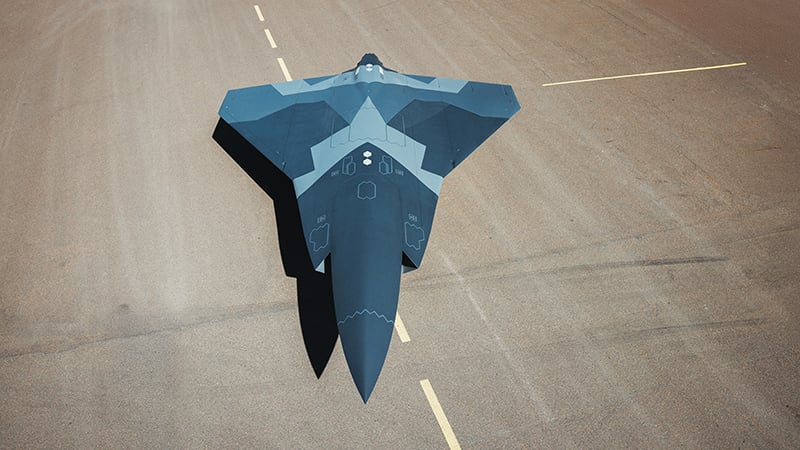
Saab’s supersonic, low-observable A3 collaborative combat aircraft concept harks back to the company’s distinctive J-35 Draken with its double-delta, blended wing body configuration.
Saab has unveiled its A3 collaborative combat aircraft concept—an autonomous, tailless, supersonic, double-delta-wing air vehicle—that could be rapidly developed in the early 2030s to provide what the company describes as a “peer-capable complement” to its Gripen E. The A3 could also serve as a conceptual and technological steppingstone toward meeting Sweden’s need for a future crewed combat aircraft in the 2040s.
Saab previously teased the A3 concept’s almost 1960s-era, J-35 Draken-like planform but never stated its intentions for the platform.
The approach contrasts with lower-cost, potentially attritable aircraft such as Boeing’s MQ-28 Ghost Bat, BAE Systems’ Brontanax and the General Atomics and Anduril designs competing in the U.S. Air Force’s Collaborative Combat Aircraft (CCA) program. The A3 appears to be more closely aligned with French plans to pair the Dassault Rafale with an uncrewed combat air vehicle derived from the Neuron.
Saab argues that CCAs will inevitably become more high-end as “mission creep” drives commanders to demand greater performance and survivability as well as more capable sensors and electronic warfare systems to perform a broader range of missions.
Moreover, given Europe’s lack of vast closed airspace such as in the U.S., CCAs will need to operate routinely in controlled airspace and therefore require certification, rather than simply being brought “out from a container in the event of war,” Saab says.
The concept emerges as the Swedish government considers how to replace its Gripen fighters in the 2040s. Stockholm launched studies in 2024 under its Combat Aviation Pathway, now known as the Swedish Concept Air Program (SWAP), to assess whether to continue developing fighters domestically and produce a Gripen successor, join an international program or simply purchase a foreign combat aircraft. The government is due to make a decision by 2030 and potentially as soon as 2028.
But the A3 is not Saab’s answer to Stockholm’s question, Peter Nilsson, head of the airframer’s advanced programs unit, told journalists ahead of the Swedish Air Force’s 100th Anniversary Airshow in Linkoping, Sweden, on Aug. 21. Rather, the CCA is an “offer” to help move the Swedish Air Force “into the unmanned space” and complement the Gripen E in combat.
Even if the service does not pursue the A3, its development would nevertheless be “a good steppingstone for the future fighter, be it manned or unmanned,” Nilsson said. “From A3, there will be an A4 and an A5, leading us up to the core fighter, . . . a step toward something awesome.” Saab’s proposed road map suggests development of that core fighter could begin in the 2040s.
As part of SWAP, Saab is rapidly prototyping a supersonic, autonomous, low-observable demonstrator—codenamed the A1—that it plans to fly within the next 15 months. The GE Aerospace F414-powered A1 is planned to be slightly larger than a Gripen E, albeit lighter. It features a conventional delta wing and canted V-tails. Wind tunnel testing has been conducted in the Netherlands, and elements of the aircraft are in various stages of assembly at Saab facilities.