// NATURE NEWS — SPAZIO & SCIENZA
Daily briefing: Glacier collapse caused Nepal’s deadly flash flood
Search author on:
PubMed
Google Scholar
Hello Nature readers, would you like to get this Briefing in your inbox free every day? Sign up here.
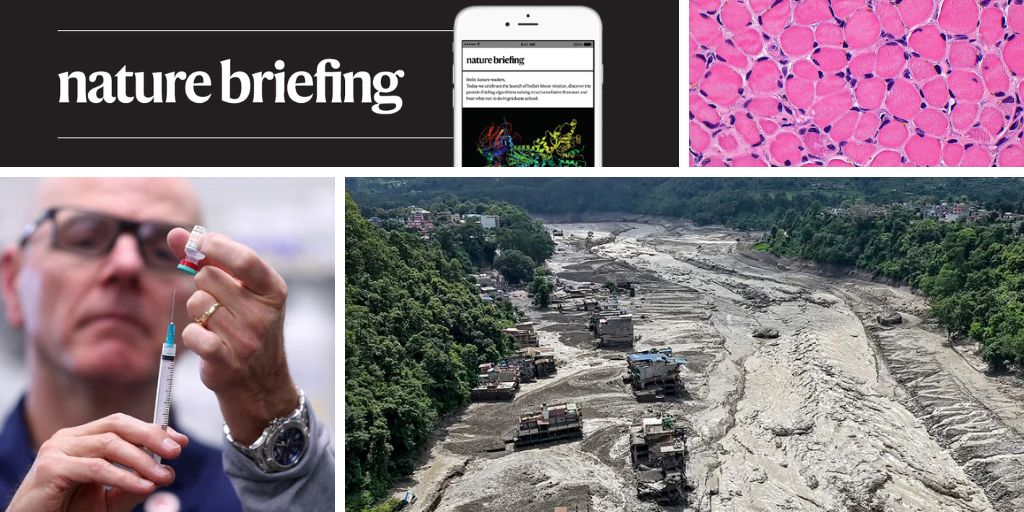
Houses are partially submerged in muddy water after flash floods in Nepal. Credit: Prabin RANABHAT/AFP via Getty
A violent flash flood on the Nepal-Tibet border that killed around 350 people was caused by a glacier collapse that led to a massive landslide. Authorities initially thought that an earthquake had caused the flooding, but the US Geological Survey later announced that the landslide was strong enough to cause a 5.2-magnitude seismic event. Scientists say it will take time to establish the extent to which global warming had a role, but melting glaciers and permafrost probably contributed to the event, says geophysicist Göran Ekström.
Scientists have long warned that the frequency of such icy avalanches in the Himalaya is increasing, writes Nepali climate researcher Sudeep Thakuri. He calls for urgent measures such as better data sharing between China and Nepal, extended satellite-based monitoring of the region and better land-use planning to reduce the risk to people and infrastructure.
A proof-of-concept experiment in mice has shown that muscle implants made from stem cells can mimic some of the benefits of exercise. In theory, such grafts — which contract continuously — could help to prevent muscle loss in people who can’t exercise because of age, illness or limited mobility. However, people would probably need multiple muscle grafts throughout the body, notes physiologist James White — not a welcome prospect for people who are already frail.
The recombinant shingles vaccine in use today has been linked to a reduced risk of heart disease and heart failure, according to a study of more than 70,000 people who received either the current Shingrix vaccine or an older formulation called Zostavax. The study has been welcomed because it only looked at vaccinated people, which is closer to an apples-to-apples comparison than including unvaccinated individuals, who tend to be unhealthier in general. Study co-author Maxime Taquet suspects that the immune-boosting component of the vaccine stops some immune cells producing an inflammatory protein called interleukin-6, which is associated with heart disease. Still, more research is needed. “We cannot definitively conclude that there is a causal link,” says epidemiologist Emily Rayens.
Figure 1 | Long-distance atmospheric link triggers a pause in Antarctic ice mass loss. Since 2020, the yearly loss of mass from the Antarctic ice sheet has slowed or even reversed. Wang et al.1 identified the mechanism behind this trend — an atmospheric ‘teleconnection’ that links a region of high sea temperatures in the Maritime Continent, called the tropical warm pool, to enhanced snowfall in East Antarctica. Temperature anomalies in the tropical warm pool (1) drive the upward convection of warm air (an effect associated with thunderstorms). Convection triggers propagating atmospheric waves called planetary waves originating in the Indian Ocean (2), which help to bring moisture from the warmer, lower-latitude regions towards East Antarctica. This creates a ‘dipole’ pattern of high- and low-pressure regions (3), driving increased snowfall in East Antarctica (4).(Adapted from Fig. 5 of ref. 1.)
For the past few decades, the Antarctic ice sheet has been steadily losing mass as a result of climate change. But between 2021 and 2023, something surprising happened: the rate of ice loss slowed dramatically, and East Antarctica actually gained a substantial amount of ice mass. Researchers have found that there is an atmospheric connection between the Antarctic and persistent warming of sea surface temperatures in the tropical warm pool (an area of water in the Pacific and Indian Oceans), writes atmospheric scientist Jonathan Wille. The abnormally warm tropical waters created a train