// SPACE.COM — SPAZIO & SCIENZA
Supermassive black holes 'too big' for the early universe may not be so massive after all
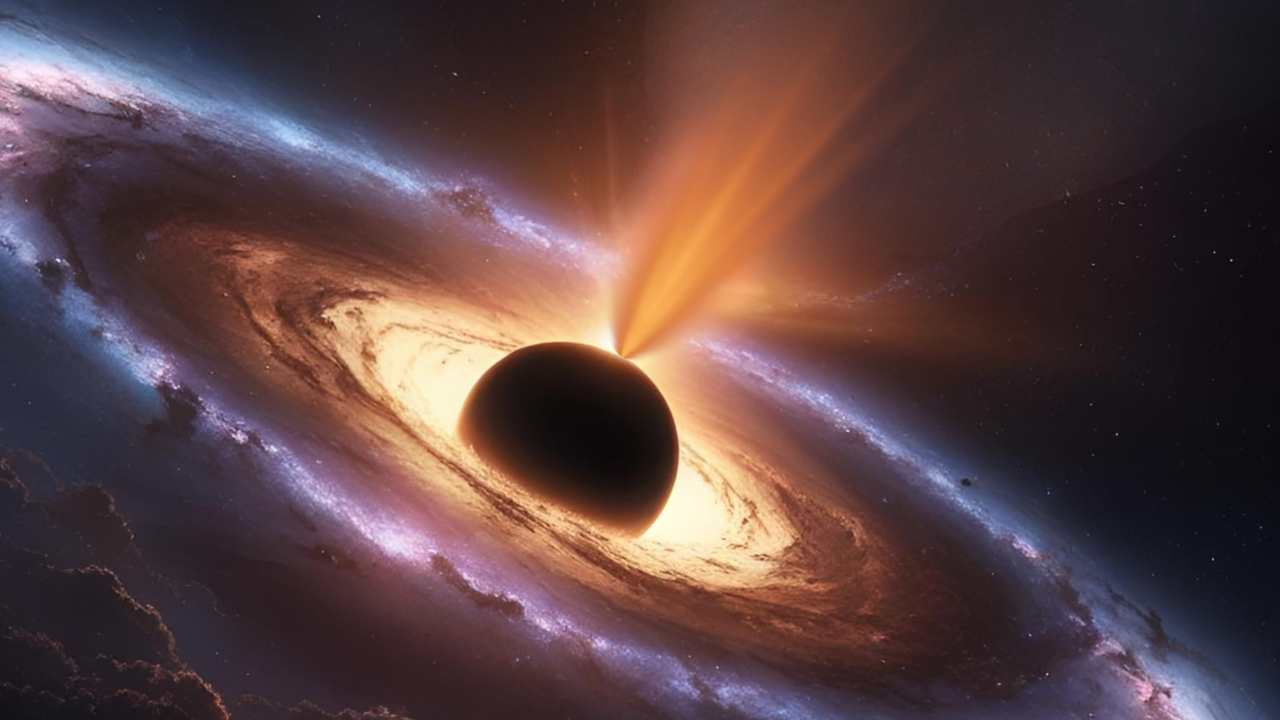
"These are still enormous objects, but they lie at the lower end of the supermassive black hole population rather than among the most extreme examples."
When you purchase through links on our site, we may earn an affiliate commission. Here’s how it works.
In the four years that the James Webb Space Telescope (JWST) has been making observations of the early universe, it has been delivering one scientific milestone after another. However, the $10 billion telescope has also left astronomers with a massive problem — literally.The JWST has been routinely spotting supermassive black holes in the early universe that, at hundreds of millions of times the mass of the sun, are too big to have grown to such monstrous sizes before the universe was even 1 billion years old. These cosmic titans are also too massive in comparison to the masses of their small host galaxies, challenging what astronomers know about the relationships between supermassive black holes and their galactic homes that are usually observed in the modern universe.
Now, new research suggests this isn't such a massive problem after all. The team behind this research thinks that it is all a matter of perspective, and that these early supermassive black holes aren't as monstrous as scientists have estimated.
"We estimate masses of roughly one to ten million solar masses, compared with the tens or hundreds of millions previously inferred," team leader Alessandro Trinca of the Italian National Institute for Astrophysics (INAF) Astronomical Observatory of Rome told Space.com. "These are still enormous objects, comparable to the four-million-solar-mass black hole at the center of the Milky Way, or a few times larger, but they lie at the lower end of the supermassive black hole population rather than among the most extreme examples. "Importantly, these masses are much more consistent with the small galaxies that host them."
While considering the mystery of "overmassive" black holes in the early universe, Trinca and colleagues picked up on another puzzle associated with these objects. To reach such sizes, these black holes must be voraciously feeding on surrounding gas and dust. Such feeding black holes and the cosmic larders of gas and dust that surround them are usually extremely bright emitters of X-rays. But this doesn't seem to be the case with the supermassive black holes in the early universe seen by the JWST. The team looked at 14 X-ray-silent supermassive black holes, finding that there is another way of considering this lack of emission.
"Almost none of them are detected in X-rays, even in very deep observations with NASA's Chandra X-ray Observatory," Trinca said. "We interpreted this lack of X-rays as a clue rather than a problem. By incorporating it into our analysis, we find that these objects are likely much less massive than previously estimated. This brings their estimated masses into better agreement with the properties of their host galaxies."
This led Trinca and the team to another conclusion: these early supermassive black holes may not be as massive as previously theorized, but they are feeding even more rapidly than was thought.
If feeding supermassive black holes blast out a lot of X-rays, then it might seem somewhat counterintuitive that ravenously feeding black holes could be X-ray "quiet."
Trinca explains that this apparent contradiction is related to what happens when a black hole accretes matter at extremely high rates. The disk of gas around the black hole becomes geometrically thick, forming a donut-like structure with a narrow funnel along the rotation axis. The hot inner region that would normally produce strong X-rays becomes surrounded by this thick disk. "As the X-rays escape, they are repeatedly scattered by the surrounding gas, losing energy before they can emerge. As a result, the black hole appears much fainter in X-rays than we would normally expect," Trinca continued. "Therefore, the lack of X-rays is not unexpected in this scena