// NATURE NEWS — SPAZIO & SCIENZA
Connectome analysis of a cerebellum-like circuit for sensory prediction
Nature
(2026) Cite this article
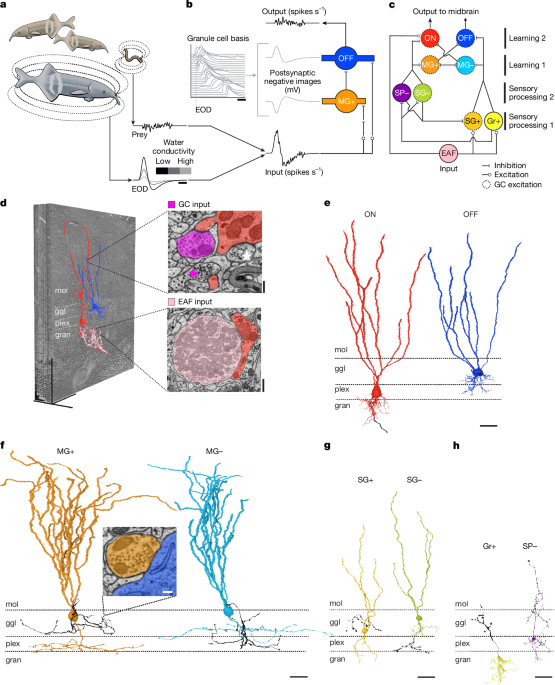
Many forms of learning, for example, learning a model of the environment or a motor skill, rely on synaptic plasticity that is widely distributed across cell types and network stages. Understanding how this distributed plasticity functions is a central challenge in neuroscience1,2,3,4,5. Here we use connectomics to map the cell types and synaptic connections underlying a form of multi-layer continual learning that cancels predictable sensory responses in a cerebellum-like structure in electric fish6,7. Our analysis shows inhibitory and disinhibitory sensory input pathways that fulfil theoretical requirements for instructing synaptic plasticity8,9, structured synaptic connectivity between network stages that solves a credit assignment problem and structured recurrent connectivity that accelerates sensory prediction and cancellation. A computational model constrained by electrophysiological recordings shows how this synaptic connectivity ensures that multiple sites of plasticity cooperate to overcome their individual limitations, resulting in cancellation that is fast, accurate and robust to noise. Overall, these findings highlight the potential of connectomics, in combination with cell-type-specific physiological recordings and computational modelling, for deciphering learning in neural circuits.
This is a preview of subscription content, access via your institution
Access Nature and 54 other Nature Portfolio journals
Get Nature+, our best-value online-access subscription
Prices may be subject to local taxes which are calculated during checkout
Original data and/or segmentations for the EM dataset are available in browsable and API-accessible (precomputed) format (https://github.com/google/neuroglancer). The dedicated web page for this project (http://efish-public.storage.googleapis.com/index.html) provides the public Google Storage addresses for each component of the EM dataset. Processed data and supporting files needed to reproduce the published results are deposited in a public Zenodo repository (https://doi.org/10.5281/zenodo.19892261)65. This repository contains any processed connectomics data, generated modelling data, electrophysiology data and supporting files that have not been previously published. Source data are provided with this paper.
The dedicated web page for this project (http://efish-public.storage.googleapis.com/index.html) provides links to all code (written in Python, v.3.8 and higher) used to analyse the segmented, agglomerated and proofread EM datasets and all code (written in Matlab 2024b, MathWorks) necessary for implementing the models used in this study. All code not previously published (along with documentation) is available from GitHub (https://github.com/neurologic/efish_em_ELL) and is additionally archived in Zenodo (https://doi.org/10.5281/zenodo.19892261)65. This Zenodo archive includes custom Python code used for dataset processing and analysis and custom MATLAB code used for modelling. All previously published code used is cited in the text.
Marblestone, A. H., Wayne, G. & Kording, K. P. Toward anintegration of deep learning and neuroscience. Front Comput. Neurosci. 10, 94 (2016).
Article
PubMed
PubMed Central
Google Scholar