// NATURE NEWS — SPAZIO & SCIENZA
Probing far-from-equilibrium dynamics of electrical double layers
Nature
(2026) Cite this article
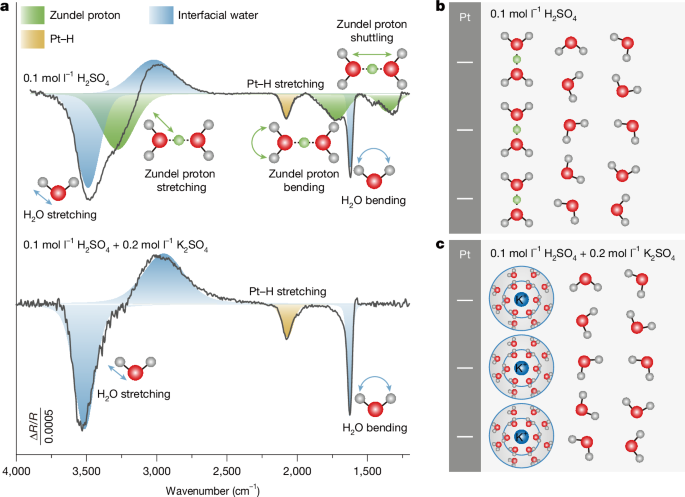
Electrified solid–liquid interfaces are central to energy and matter conversion in biological1 and electrochemical systems2,3,4, in which intense local electric fields govern reaction kinetics5,6,7,8,9. Yet, under realistic electrocatalytic conditions involving rapid charge transfer and far-from-equilibrium dynamics, the molecular structure and evolution of the electrical double layer (EDL) remain poorly understood. Classical EDL models, derived under equilibrium and non-reactive conditions, cannot capture the interfacial processes emerging at reactive interfaces10,11,12,13,14,15,16. Here we develop an integrated experimental–computational framework to directly resolve EDL dynamics under the hydrogen evolution reaction (HER). Chemically stable nanostructured Pt film electrodes enable high-sensitivity, time-resolved surface-enhanced infrared absorption spectroscopy (SEIRAS) at increased overpotentials, whereas machine-learning molecular dynamics (MLMD) captures interfacial charge fluctuations and solvent dynamics over nanosecond timescales. This combined approach reveals a nonlinear, two-phase evolution of the inner layer that intensifies the local electric field. Time-resolved spectra further uncover irreversible restructuring of interfacial water during cyclic potential modulation. These findings show that ions and interfacial water respond asynchronously under the condition far from equilibrium, establishing a quantitative molecular framework for understanding electrostatic potential variations, interfacial electrostriction of ions17,18,19, electrolyte effects20,21,22,23,24 and rational electrolyte design for energy conversion technologies.
This is a preview of subscription content, access via your institution
Access Nature and 54 other Nature Portfolio journals
Get Nature+, our best-value online-access subscription
Prices may be subject to local taxes which are calculated during checkout
All data are available in the main text and its Supplementary Information. Source data are provided with this paper. Extra data are available from the corresponding authors on request.
The code and database for DPχ construction used in this study are available at GitHub (https://github.com/cjxxjc729/DPx-preview).
Gonella, G. et al. Water at charged interfaces. Nat. Rev. Chem. 5, 466–485 (2021).
Article
CAS
PubMed
Google Scholar