// NATURE NEWS — SPAZIO & SCIENZA
Probing the proteome at cellular scale
Michael Eisenstein is a freelance writer based in Philadelphia, Pennsylvania.
Search author on:
PubMed
Google Scholar
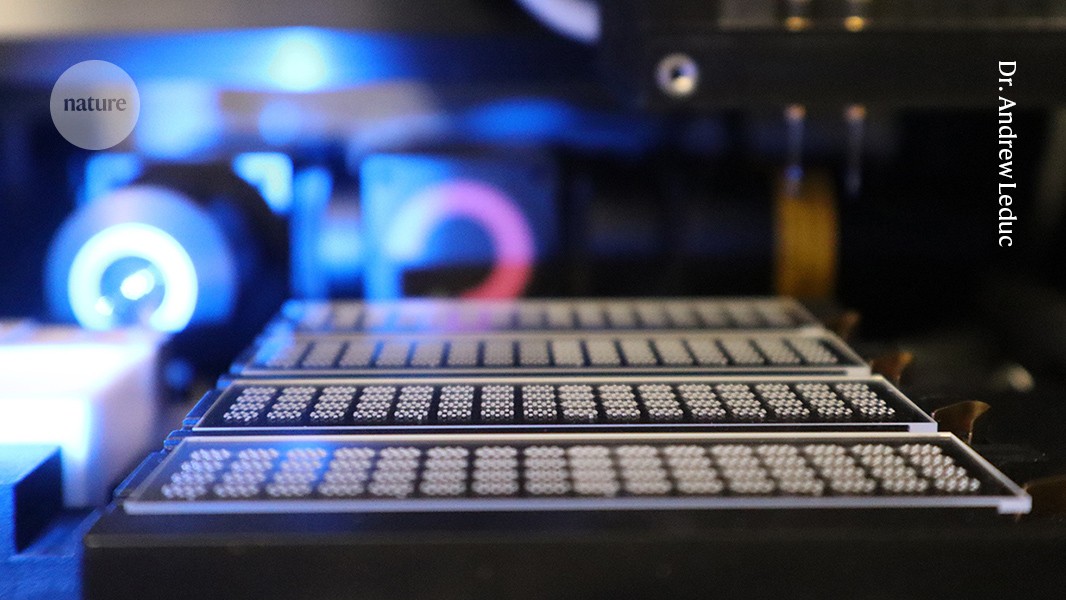
Single-cell samples arrayed on glass slides for analysis by mass spectrometry. Credit: Andrew Leduc
When a fertilized mammalian egg divides, it yields two seemingly identical daughter cells. Some of their descendants generate the diverse organ systems of the embryo, while others form extra-embryonic tissues that sustain the developmental process.
In 2025, researchers used a cutting-edge technique known as single-cell proteomics (SCP) to show that even in the two first-generation cells, this division of labour is already established1. Nikolai Slavov at Northeastern University in Boston, Massachusetts, who co-directed the study with fellow cell biologists Magdalena Zernicka-Goetz and Tsui-Fen Chou at the California Institute of Technology in Pasadena, says that the protein contents of these two cells, which were termed ‘alpha’ and ‘beta’, reveal distinct properties and fates. “Beta cells were more likely to give rise to healthy embryos than the alpha cells,” he says, whereas alpha cells typically formed extra-embryonic tissues. The team could trace these identities back to fertilization.
Where do proteins go in cells? Next-generation methods map the molecules’ hidden lives
Other questions are also yielding to the technology. Researchers now recognize, for instance, that many of the most clinically significant events in the formation of tumours originate from individual cells camouflaged in the chaotic tumour environment. “Single-cell proteomics may help us understand why patients have different outcomes due to tumour evolution, immune responses and cell differentiation — all driven by cellular heterogeneity,” says Yu-Ju Chen, a mass spectrometrist at Academia Sinica in Taipei.
Just a few years ago, protein biologists largely dismissed the possibility of single-cell proteomics — profiling thousands of proteins in individual cells — as the stuff of science fiction. “I’m almost on the record as saying, ‘not in my lifetime’, because it seemed to be so far off,” says Matthias Mann, a proteomics researcher at the Max Planck Institute of Biochemistry in Martinsried, Germany. But over the past decade, SCP has become not only possible but practical — and scientifically informative. Mann himself is now an avid practitioner, using SCP to study illnesses ranging from liver conditions to Alzheimer’s disease. The bar to entry remains high, however, and the need for expensive equipment, deep expertise and methodological precision to process cell-scale volumes of protein still limits the potentially transformative impact of this technology.
Biology is already deep in the single-cell era, but most such analyses focus on the transcriptome. Profiling gene expression at the level of the individual cell can provide valuable information about a cell’s identity or physiological state. But researchers cannot necessarily predict the protein contents of a cell from its RNA alone — not every RNA gets translated, and numerous factors shape the timing and extent of protein production from a given transcript. Many disease mechanisms can best be understood by surveying the protein contents — for example, the pathology of Alzheimer’s and Parkinson’s disease is strongly linked to aberrant aggregates of protein. “The proteome reflects the current state of the cell,” Mann says.
To survey that state, proteomics researchers typically work in bulk, pooling and analysing thousands or millions of cells using mass spectrometry (MS). This technique uses specialized instruments that break samples down into ionized pieces, which are then analysed in terms of their mass and charge. The resulting ‘fingerprint’ enables precise identification of the molecule from which the fragment originated, and researchers can routinely detect 10,000 or more distinct proteins per sample. B