// NATURE NEWS — SPAZIO & SCIENZA
Within-family effect of ancestry on complex traits in a Mexican population
Nature
(2026) Cite this article
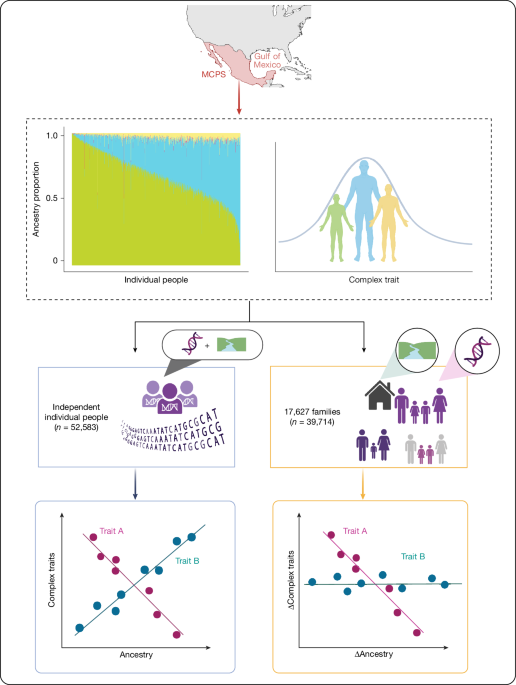
Human populations differ in disease prevalence and phenotypes, but the extent to which differences are caused by genetic factors is unknown for most complex traits. Comparing phenotypic means across populations is confounded by environmental differences and using polygenic predictors can lead to biased inference1,2. Family-based analyses of people of genetically admixed ancestry enable estimation of ancestry effects unconfounded by ancestry–environment correlations. Here we leverage genetic data from admixed adults in the Mexico City Prospective Study3,4 to estimate within-family ancestry effects5. We assessed genetic ancestry and 15 complex traits in 52,583 unrelated people and 39,714 relatives from 17,627 families. At the population level, relative to European ancestry, the effect of Indigenous American ancestry was −1.98 s.d. (P < 2 × 10⁻¹⁶) for height and a natural log odds ratio of 1.73 (95% confidence interval, 1.54–1.92) for type 2 diabetes. Within families, the effect of Indigenous American ancestry was −1.51 s.d. (P = 10−8) for height and natural log odds ratio of 5.13 (95% confidence interval, 2.48–7.78) for type 2 diabetes. These effects are supported by between-ancestry differences in trait-increasing allele counts and evidence of selection at trait-associated loci. We found no within-family ancestry effect on educational attainment or other traits despite significant associations at the population level, implying environmental causes or confounding. Overall, this study provides an experimental design to study between-ancestry genetic effects and identifies significant ancestry differences for height, type 2 diabetes and metabolic traits in a genetically diverse population from Mexico City.
Natural selection and genetic drift produce differences in allele frequencies among populations, which could differentially shape phenotype distributions6. In humans, some phenotypic differences among genetic ancestry groups are known to have a genetic basis, including pigmentation7, drug metabolism8 and the prevalence of single-gene disorders9,10. (Throughout this paper, we use the term ‘genetic ancestry’ to refer to inherited variation from ancestral populations that differ in allele frequencies across the genome and that can be inferred from genetic data. We acknowledge that there is no consensus on terminology11,12 and that human populations are not genetically discrete.) Whether inherited genetic differences also contribute to population differences in complex traits such as height and common diseases such as type 2 diabetes (T2D) remains poorly understood. Here we combine large-scale genomic data with a within-family study design to address this question.
In admixed populations, the genomes of individual people vary in their proportions of different founder ancestries, and these proportions can be estimated with genetic markers13. Ancestry proportions can correlate with trait values at the population level14,15,16, but may also track environmental effects, confounding attempts to separate genetic from non-genetic contributions to trait variation. For example, in Mexico, obesity17 and T2D are highly prevalent and associated with ancestry18, but the underlying mechanisms remain unclear.
In gene–trait association studies, the gold standard for inferring causal effects of genotypes on phenotypes is to perform a within-family association analysis, which conditions on parental genotypes19,20. Within-family genetic variation is due to random segregation of parental alleles during meiosis, therefore associations between within-family genotype variation and phenotype are expected to be due only to the causal effects of inherited alleles21,22,23. Here ancestry proportions are first inferred from genotype data, and we then apply the same underlying logic to estimate within-family effects of genome-wide ancestry. We note that, without additional supporting evidence, a wi