// NATURE NEWS — SPAZIO & SCIENZA
Integrated signatures define mutational processes in prostate cancer
Nature
(2026) Cite this article
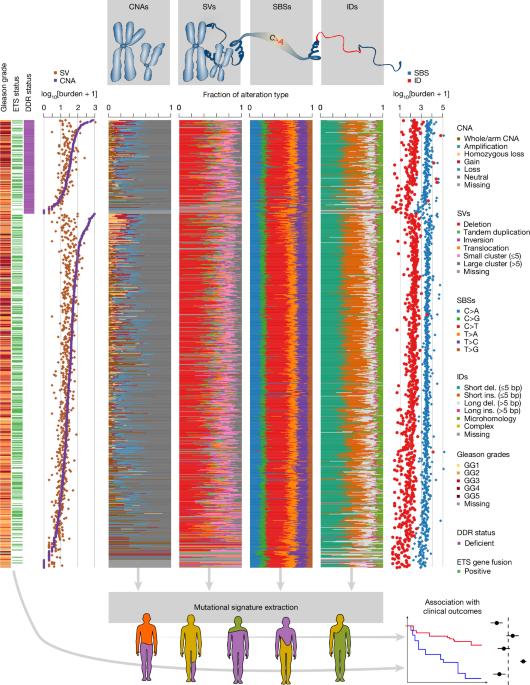
Prostate cancer follows a long and heterogeneous disease course with incompletely understood aetiology1. Here we dissect the mutational processes shaping the genomes of 959 donors from the Pan Prostate Cancer Group and assess their clinical relevance. By integrating de novo extracted single-base substitution, insertion–deletion and copy-number signatures with six novel complex structural variant signatures, we identify eight integrated mutational footprints (IMFs) that collectively explain the mutational processes in 85% of primary prostate cancer genomes. IMFs were strongly influenced by regional biases in the genome, most prevalently androgen receptor-mediated mutagenesis and replication stress. Four IMFs, present in 37% of primary tumours, were significantly associated with shorter time to metastasis. These included reactive oxygen-species-driven mutagenesis and both canonical and non-canonical homologous recombination deficiency, the latter being enriched in patients of African ancestry. Extending to the metastatic setting, we found that IMFs predicted sensitivity to androgen receptor pathway inhibitors. Taken together, our study delineates the aetiologies and mutational processes that drive the genomic and clinical heterogeneity of prostate cancer, introduces IMFs as a unifying framework, and highlights their potential to improve both risk stratification and biomarker-guided treatment selection.
Prostate cancer is the second most common cancer globally2, and the fifth leading cause of cancer death among men3. Despite its high prevalence and substantial burden on patients and society, the aetiology underlying the disease’s clinical heterogeneity, from indolent to highly lethal, remains poorly understood. Prostate cancer is influenced by family history, inherited germline mutations and patient ancestry4. Mutations in DNA damage repair (DDR) genes such as BRCA1 or BRCA2, associated with homologous recombination deficiency (HRD), are present in approximately 2% of localized disease and 15% of metastatic castration-resistant disease5. Other clinically relevant but rare DDR pathways (reviewed previously6) include mismatch repair deficiency (MMRd), identified in 2–3% of primary prostate cancer7,8, and CDK12 inactivation, associated with a high burden of somatic tandem duplications9,10,11. As a hormone-driven disease, androgen signalling is pivotal, mediated by activation of the steroid-binding androgen receptor (AR) transcription factor1. AR activation by testosterone and dihydrotestosterone causes widespread changes in transcriptional activation of AR-target genes, also termed the AR cistrome12,13. Moreover, both single-nucleotide variants (SNVs) and structural variants (SVs) accumulate at AR-binding sites (ARBSs)14, with the latter associated with chromoplexy15, creating chains of interchromosomal complex SVs (cSVs).
Beyond these specific contributions, the broader landscape of oncogenic mutational processes and their underlying aetiologies remains largely undefined. To characterize mutational processes, mathematical methods are commonly used that identify mutational signatures, or footprints, that correspond to each specific mutational process. Methods have been developed to identify signatures based on SNVs and insertion–deletions (indels)16 and, more recently, copy-number alterations (CNAs)17 and cSVs18. Previous studies have mainly investigated these mutational signatures separately, identifying a few common mutational processes in prostate cancer including clock-like mutagenesis (SBS1 and SBS5), HRD (SBS3 and ID6), MMRd (SBS15, SBS21 and SBS44)16,19,20,21 and complex genomic configurations, mainly chromoplexy (approximately 20%)15,18 and chromothripsis (20–40%)22,23. Despite these important findings, a fundamental appreciation and understanding of the aetiologies and mutational processes driving prostate cancer remains unexplored.
The Pan Prostate Cancer Gro