// NATURE NEWS — SPAZIO & SCIENZA
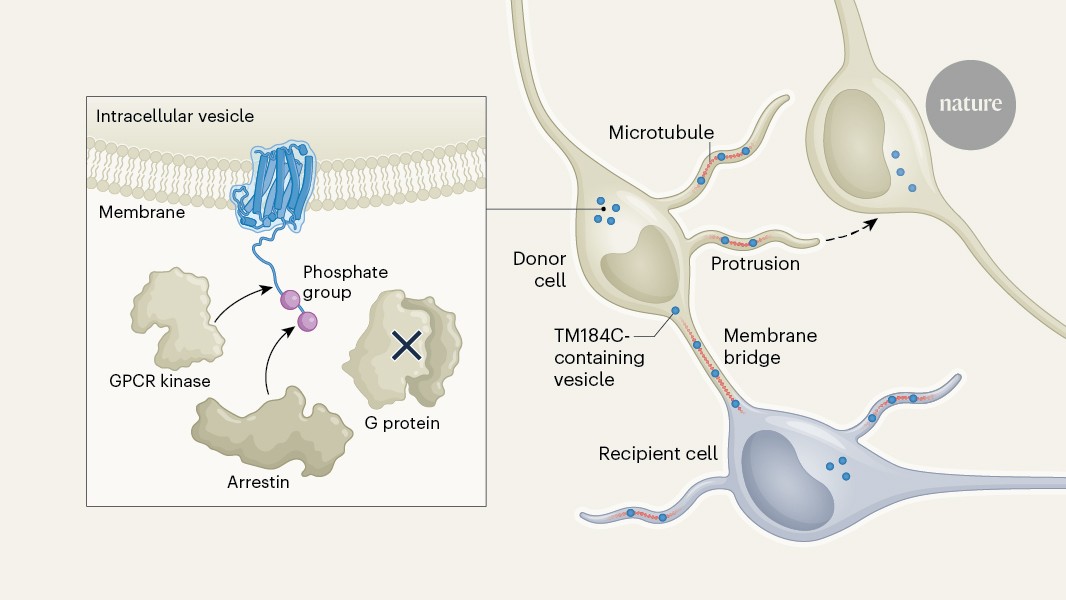
‘Superdark’ protein looks like a G-protein-coupled receptor — but shows unconventional behaviour
Nil Casajuana-Martin is in the Center of Excellence for Data Driven Discovery, Department of Structural Biology, St. Jude Children’s Research Hospital, Memphis, Tennessee 38105, USA.
Search author on:
PubMed
Google Scholar
M. Madan Babu is in the Center of Excellence for Data Driven Discovery, Department of Structural Biology, St. Jude Children’s Research Hospital, Memphis, Tennessee 38105, USA.
Search author on:
PubMed
Google Scholar
Most human proteins have been catalogued. However, many remain part of the ‘dark proteome’, which comprises proteins with functions that cannot be readily inferred because their amino-acid sequences are not similar to those of characterized protein families1. Writing in Nature, Lee et al.2 use predicted protein structures to shine a light on this poorly understood group of proteins.
Access Nature and 54 other Nature Portfolio journals
Get Nature+, our best-value online-access subscription
Prices may be subject to local taxes which are calculated during checkout
Oprea, T. I. et al. Nature Rev. Drug Discov. 17, 317–332 (2018).
Article
PubMed
Google Scholar