// SPACE.COM — SPAZIO & SCIENZA
On this day in space! Sept. 10, 2011: NASA launches GRAIL probes to the moon to map lumpy lunar gravity
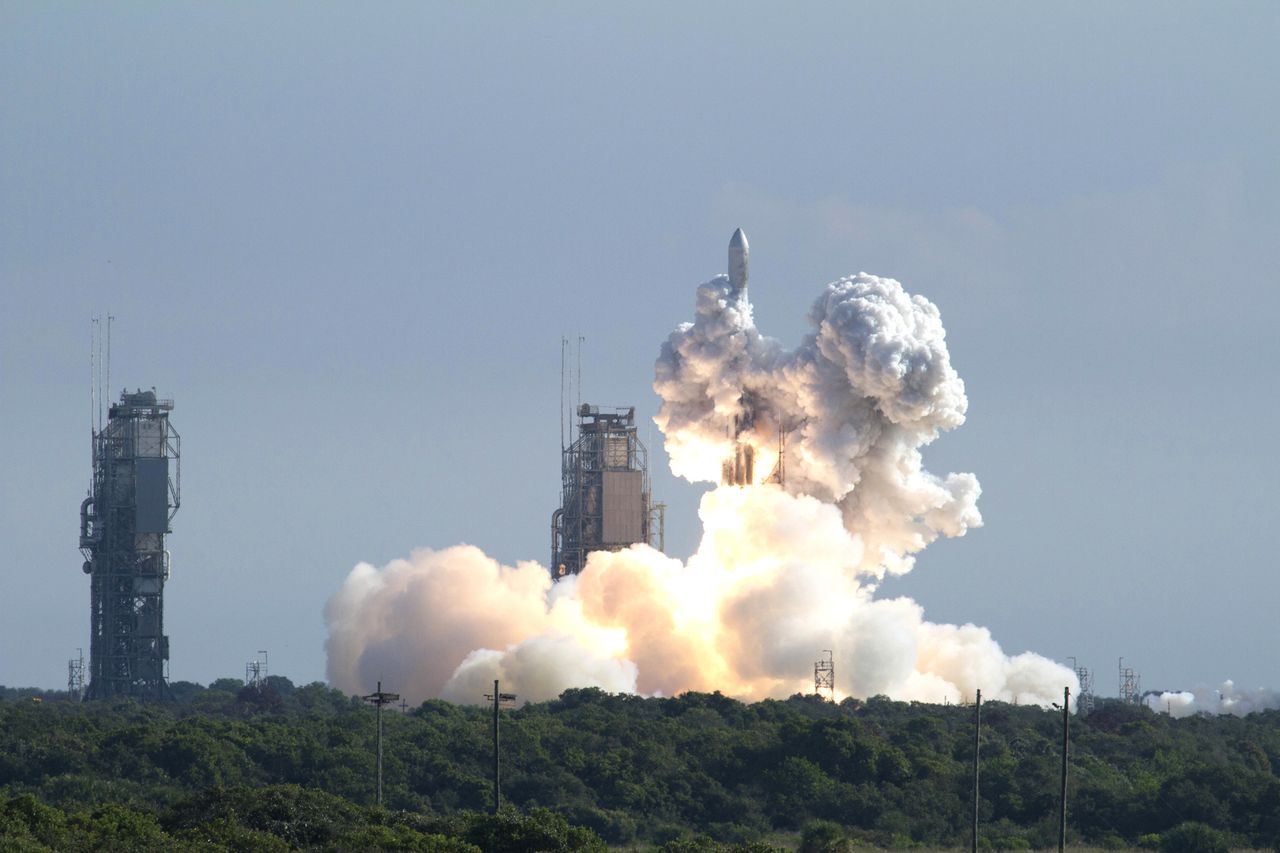
The GRAIL probes launched on a mission to study the moon's lumpy gravity caused by strange mascons.
When you purchase through links on our site, we may earn an affiliate commission. Here’s how it works.
On Sept. 10, 2011, NASA's GRAIL spacecraft launched on a mission to the moon!
GRAIL, which stands for Gravity Recovery and Interior Laboratory, was sent to the moon to map its gravitational fields. Scientists could study the moon's interior structure by looking at maps of the moon's gravity.
Asteroid impacts from billions of years ago left dense pockets of material under the lunar surface, which can exert extra gravitational pull on spacecraft orbiting the moon. So by measuring that gravitational pull, the GRAIL mission could reveal information about what lies beneath the surface.
The mission actually consisted of two twin spacecraft named Ebb and Flow, which would fly in tandem around the moon to map variations in its gravitation field. Both lifted off on the same Delta II rocket from Cape Canaveral, Florida and arrived in lunar orbit almost four months later.
They mapped the moon for about nine months before NASA decided it was finished with the mission, and the two orbiters crashed into the moon.
The moon is a weird place. It may look like a cold, gray ball of solid rock, but its density varies from location to location due to odd "mass concentrations" (or mascons for short) buried under the lunar surface. That leads to a strange, lumpy gravity that's not uniform across the lunar surface.
That's where GRAIL's Ebb and Flow probes came in. Each of the twin spacecraft carried three instruments to map the interior of the moon. Those included a Lunar Gravity Ranging System, a Radio Science Beacon and a camera called MoonKam Lunar-Imaging system.
Together, the instruments mapped the mascons on the moon in extreme detail to monitor where lunar gravity increased from the norm. Astronomers had long suspected that mascons on the moon and other planets formed during violent asteroid impacts.