// NATURE NEWS — SPAZIO & SCIENZA
Daily briefing: Skeleton teeth show evidence of the earliest known habitual drug use
Search author on:
PubMed
Google Scholar
Hello Nature readers, would you like to get this Briefing in your inbox free every day? Sign up here.
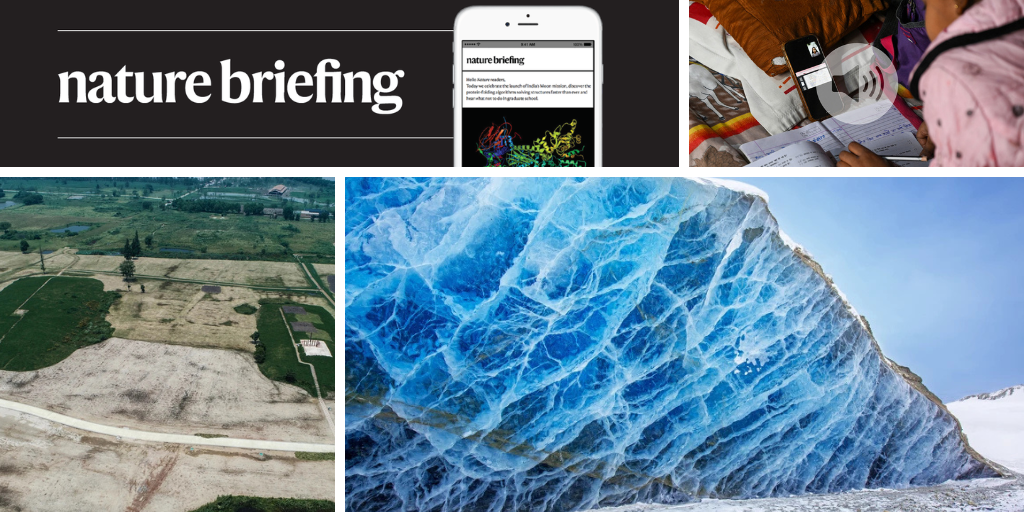
Glaciers shape the landscapes of Spitsbergen, an island of Norway’s Svalbard archipelago in the Arctic Ocean.Credit: Arterra/Sven-Erik Arndt/UIG/Getty
Emotionally engaging forms of communication are more effective than scientific facts alone in motivating climate action, finds a review of 71 studies. Messages focused on individual responsibility had little impact — and sometimes backfired. “The emotions you feel when you watch a nature documentary, see the northern lights or witness the birth of a new animal imbue these events with meaning,” says psychologist and co-author Tobias Brosch. “They may also drive you to look better after our environment — by volunteering your time, donating or voting for climate-friendly parties.”
Reference: Journal of Environmental Psychology paper
Traces of mind-altering substances found in the teeth of two skeletons discovered in Indonesia could be evidence of the earliest known habitual drug use. The skeletons’ teeth showed considerable signs of wear and contained traces of the compound arecoline, which suggest that the pair regularly sucked on psychoactive betel nuts. One of the skeletons dates to 16,000–25,000 years ago, which hints that this behaviour predates betel chewing, a drug-taking method still in use today.
Liangzhu City in what is now China was built some five millennia ago using techniques passed down through generations.Credit: Wang Chuan/Visual China Group/Getty
The ruins of the 5,000-year-old city of Liangzhu in China show evidence of engineering prowess on a challenging waterlogged site. An analysis of layers of earth suggests that builders created raised mounds of soil along with blocks made up of hundreds of bundles of wet clay wrapped in grasses. The grass-wrapped clay technique was also used to build up dams and city walls.
When the underwater Hunga Tonga–Hunga Haʻapai volcano in the island nation of Tonga erupted in January 2022, it triggered tsunamis that struck the coasts of nearby islands with little warning, producing waves more than 40 metres high. Now researchers have found telltale signals in data captured by seismic sensors hundreds to thousands of kilometres away. These could serve as early warnings of tsunamis generated by underwater eruptions.
Graduate students increasingly use artificial-intelligence tools, but many fear that using them could erode the very skills a doctorate is meant to build. In a 60-minute webinar organized by Nature’s careers team, a panel will discuss how PhD programmes and students are adapting. The live event takes place on 23 September at 14:00 UTC (15:00 BST).