// HACKER NEWS — CYBERSECURITY
Datamimic – don't let your coding agent invent its own test world
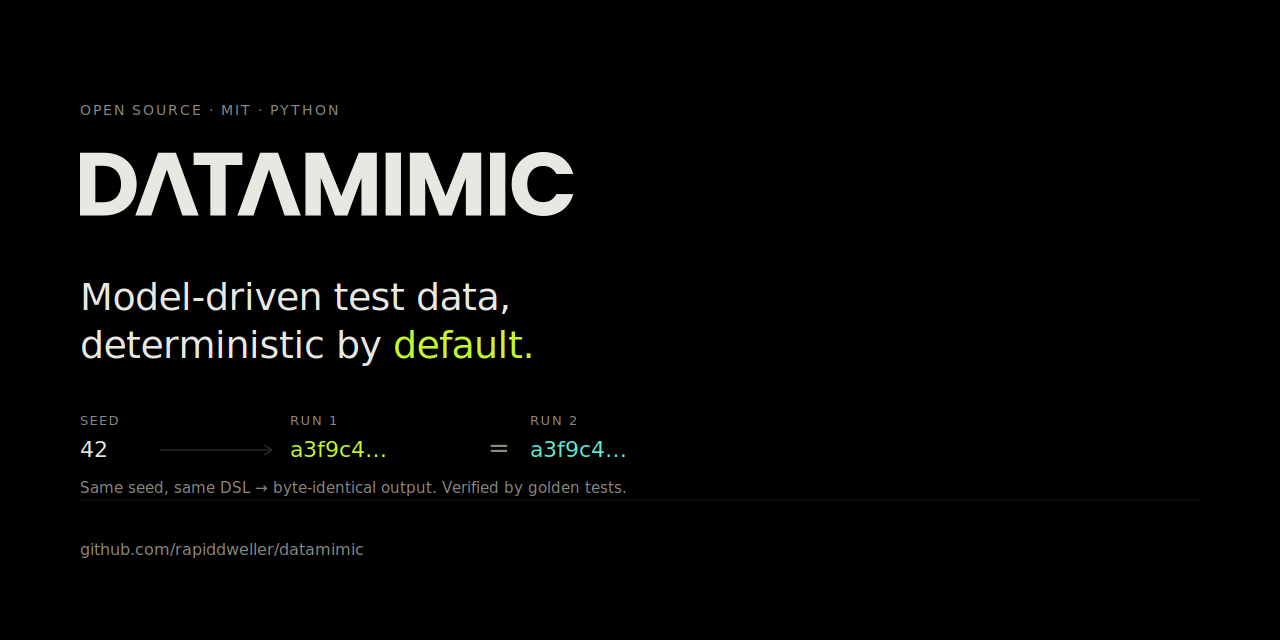
This repository contains the DATAMIMIC Community Edition (CE). MIT-licensed, Python-native, MCP-ready.
CE is fully usable standalone for deterministic synthetic data generation and PII-aware pseudonymization. The Enterprise Platform adds governed workflows, PII scanning, role-based access, audit logging, scheduling, multi-system execution, and the full operational layer that regulated enterprises require.
👉 Enterprise Platform: datamimic.io | 📘 Docs: docs.datamimic.io | 📅 Book a strategy call: datamimic.io/contact
🤖 AI agent? Start at AGENTS.md and use the project CLI: preserve new intent as model.dm.json, submit an early best attempt via datamimic scaffold ... --format json, repair from the structured issues, declare an expectation per stated requirement, and stop on verified=true. Existing raw XML uses lint plus bounded dry-run.
DATAMIMIC CE is the open-source deterministic data engine at the core of the DATAMIMIC Enterprise Platform. It is usable standalone for synthetic data generation and PII-aware pseudonymization in any local, CI, or agent-driven workflow.
The Enterprise Platform adds the governed workflows, scanners, dashboards, and execution layer that regulated enterprises require for production-scale test-data operations.
Deployed in regulated EU banking environments for deterministic test data across Oracle, MongoDB, and Kafka pipelines. Reference customers available under NDA — see also datamimic.io case studies.
The CLI is the baseline agent contract. Install CE with pip install datamimic-ce;
inside this checkout, use .venv/bin/datamimic so a stale global installation cannot
change the available schema or commands.
capabilities, authoring-reference projections, and the commands shown with
--format json return machine-readable JSON. On a failed scaffold attempt, change
model.dm.json using its structured validation issues, typed repair, or rule
diagnostics before retrying. A typed max_count remediation instead changes only
the bounded scaffold parameter to at least its reported minimum. Never repeat an
identical failed call. A successful scaffold result is terminal for authoring, so
do not lint or dry-run its generated XML again. Exact source fragments are
discoverable through queries such as --category source --kind memstore.
When the calling environment already exposes DATAMIMIC MCP tools, they map to the same
canonical contracts and implementations: reference → datamimic_reference,
scaffold → datamimic_scaffold, lint → datamimic_check, and dry-run →
datamimic_run. Install the adapter with pip install "datamimic-ce[mcp]";
registration details belong in the MCP quickstart,
not in the authoring workflow. The adapter intentionally exposes only the four
canonical reference, scaffold, check, and bounded-run operations; domain generation
remains a Python/CLI capability rather than a parallel MCP authoring path.