// NATURE NEWS — SPAZIO & SCIENZA
Electrically controllable superconducting memory effect in UTe2
Nature
volume 657, pages 632–637 (2026) Cite this article
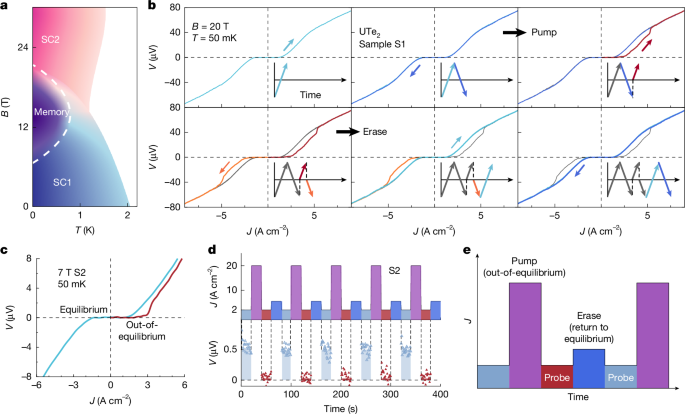
Multiphase superconductors—materials that host two or more distinct superconductive phases—are exceptionally rare. Examples include heavy-fermion CeRh2As2 alongside some uranium compounds such as UPt3 and URhGe (refs. 1,2,3). In the multiphase p-wave superfluid 3He, complex vortex dynamics can occur at the phase boundary between the A and B phases4,5. Here we study the p-wave superconductor candidate UTe2 (refs. 6,7,8). On applying a magnetic field to access an intermediate regime straddling two distinct superconducting phases9,10, we find that direct current pulses can push the material in and out of a metastable state that has an enhanced critical current density Jc. This switching is controllable by the strength and duration of the stimuli, with the system ‘remembering’ whether it is in the high or low Jc state for extended periods. We interpret this phenomenology to be due to the quenching of a disordered out-of-equilibrium glassy vortex state under perturbation, which has stronger pinning forces and thus higher Jc. The equilibrium vortex lattice is reattained by annealing the system with a gradual current ramp, returning it to the original state. Rather than requiring proximate magnetic or semiconducting interfaces11,12,13,14, this memory functionality seems to be an intrinsic property of UTe2 rooted in the superconducting order itself. Our findings underscore the rich complexity of multiphase quantum vortex matter.
If a computer could be assembled from superconducting components, the energy efficiency would far surpass that of conventional electronics. Historic research efforts towards this goal yielded pivotal breakthroughs in the development and discovery of scanning tunnelling microscopy15 and high-temperature superconductivity16. Although recent strides have been taken in advancing superconducting rectification17,18 and switching19 technologies, realizing read/writable memory functionality in superconducting platforms has remained challenging.
Encodable superconducting memory functionality has been demonstrated in ferromagnet–superconductor heterostructures12,13, as well as through history-dependent trapping of magnetic flux20,21. In some type II superconductors such as NbSe2, a hysteretic modulation of the critical current density Jc has been observed near a so-called ‘peak-effect’22 region in which Jc suddenly increases on approaching the upper critical field. Such behaviour is understood to be governed by a dynamic competition between the injection of a highly disordered, strongly pinned vortex phase through surface edge barriers and the subsequent annealing of this disorder by a bulk transport current23. By tuning the amplitude, frequency and direction of the driving current, the spatial footprint of this disordered vortex matter may be programmably manipulated24. The material effectively archives its electrical history within this spatial distribution, giving the vortex landscape the ability to effect non-volatile information storage25.
Here we study vortex dynamics within the multiphase spin-triplet superconductor candidate UTe2 (refs. 6,7,8). In a specific portion of the complex phase landscape, we observe hysteretically tunable Jc properties analogous to those of NbSe2 (ref. 23). However, rather than becoming pronounced near to the critical temperature, as per the peak effect, in UTe2, this ‘memory effect’ manifests at very low temperatures over a magnetic field interval in which this material is known to transition between two distinct superconducting phases9,10. We therefore posit that, while in NbSe2 thermally induced competition between elastic and pinning energies yields metastable memory phenomenology23, by contrast, in UTe2, it seems that competing interactions between two distinct vortex structures—each native to their separate superconducting phases—drives the observed superconducting memory effect.
UTe2 is an