// NATURE NEWS — SPAZIO & SCIENZA
Predictors and prevalence of support for white nationalism in the United States
Nature
(2026) Cite this article
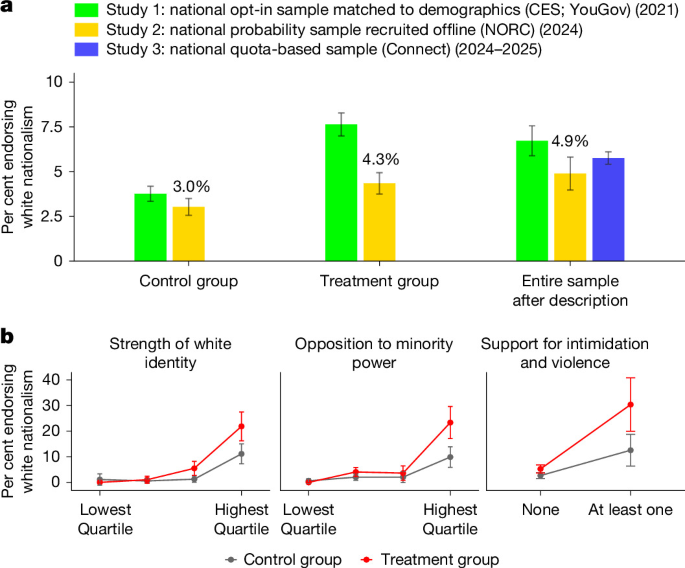
White nationalism has become increasingly visible in American public life1,2,3,4,5,6,7,8,9,10. Yet we lack knowledge of the predictors and prevalence of explicit support for this ideology, as survey research has treated it as a latent construct captured through indirect indicators11,12,13,14,15. We introduce and validate a measure that informs respondents of the core tenets of the white nationalist movement and then asks whether they support the movement. Expressed support is distinct from organizational affiliation with the movement, which we do not measure. Here we show with three national surveys of non-Hispanic white adults (conducted from 2021 to 2025) that support for white nationalism is (1) higher among white people encountering personal hardship and local social distress, consistent with strain theories3,16; (2) unrelated to local racial composition or recent demographic change, complicating status threat accounts4,17,18; and (3) elevated among white people with close friendships primarily online, consistent with theories of extremism driven by online mobilization7,10,19. Support for white nationalism is more common among white people with lower incomes and education, Republicans and conservatives, and those who are politically disaffected. In our national probability sample, prevalence of support was estimated at 4.9% of white adults, including 13.5% of white men aged 18–29. Support for white nationalism seems to constitute a discrete dimension of white racial attitudes, and many white people who endorse its core ideas are unaware of the label.
White nationalism has become more visible in American public life in recent years. Those who call themselves white nationalists believe that shifting demographics pose an existential threat to the white race, which they view as culturally superior and deserving of power over all other groups in the United States. A loosely organized white nationalist movement operates largely out of view through paramilitary groups, small gatherings, white power music performances and online networks, inspiring the lone actors who have committed many of the nation’s most murderous acts of racial terror. Movement participants periodically emerge into the public eye with rallies and other direct actions, some of which are linked to political violence1,2,3,4,5,6,7,8,9,10.
Yet we know little about the predictors and prevalence of white nationalist views in the wider US white population. It is possible that many white people are unaware of this term, but are nevertheless sympathetic to white nationalist ideology. The scholarly literature employing surveys to assess support for white nationalism has thus far construed support for the movement as a latent construct to be measured indirectly (without using the term white nationalism in survey questions). It has also considered white nationalism as a predictor of other attitudes—including opinions about political violence, criminal justice, immigration and the COVID pandemic—rather than as a phenomenon to be explained in its own right11,12,13,14,15. We note here that white nationalism is distinct from Christian nationalism—an ideology that seeks a fusion of Christianity and American civic life20, and whose tenets are endorsed by nearly equal shares of white and non-white people21.
We introduce a new measure of support for white nationalism that defines this term for respondents and then asks whether they support the white nationalist movement. Our strategy is to assess whether respondents endorse a statement summarizing core beliefs associated with white nationalist ideology when presented with that statement in a survey context. Endorsement of the statement is distinct from organizational affiliation with the white nationalist movement, which these data do not measure. Our findings contribute to a growing body of work employing national sample surveys to examine the politicized nature of