// NATURE NEWS — SPAZIO & SCIENZA
A thermodynamically favoured molecular computer
Nature
volume 657, pages 646–652 (2026) Cite this article
Computers, like life, are usually out of equilibrium1,2. Undesired error states are thwarted by energetically costly kinetic control processes: proofreading of biological polymers, error correction in computing and redundancy in molecular programming. Unlike life as we know it, theory shows that computation can be embedded in a system relaxing to a thermodynamically favoured equilibrium state3,4. Machine learning and search algorithms use this idea5,6, although executed on non-equilibrium architectures at enormous energy cost. Physically implementing thermodynamically favoured computation requires a programmable medium amenable to energy landscape engineering. Here we demonstrate a thermodynamically favoured Scaffolded DNA Computer (SDC) on 10 programs, including Multiplication-by-3, Division-by-2, 8-bit Parity-detection and Addition of 25-bit numbers—a 100-bit computation. SDC algorithms have simple experimental protocols, can be reused dozens of times and small instances run in under a minute. Mathematical, physical and computer science principles explain why the SDC is thermodynamically favoured, why it does not require error-correction or precise kinetic control, and how it is programmable and scalable. This work creates a new way to think about equilibrium computation in all manner of synthetic systems.
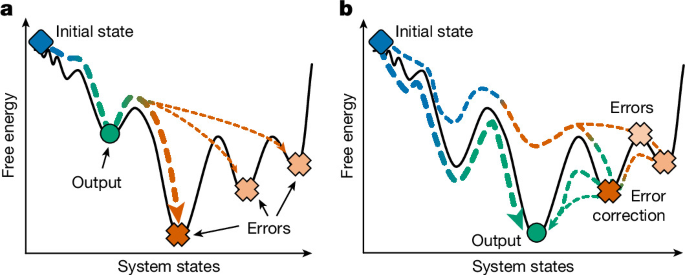
Analogous to living systems that consume fuel to stave off thermodynamic heat death, computers are typically out of equilibrium, consuming energy to enforce logical correctness. The massive gap between modern computing energy consumption7,8 and minimal theoretical requirements2,4,9,10 leaves substantial room to rethink computer design. A perhaps counter-intuitive avenue is to design a programmable physical system whose equilibrium encodes the output of an algorithm3, allowing the computer to simply drift to the right answer (Fig. 1 and Supplementary Note 1). This notion has appeared in various forms3,4,7,11 but contrasts with popular computing methods; however, it is still not widely adopted. There are several challenges: we need a physical implementation that is computationally expressive and programmable, and has easily prepared initial states, and a controllable energy landscape for rapid navigation to target outputs with high probability.
a, Classical molecular computers have an intended target or final state that is out of equilibrium. Digital electronic computers have similar issues, in which decades of research have lowered error rates but with large energetic costs7. b, Thermodynamically favoured computation has the output state being the energetically most favoured. Also, input states should be easy to prepare, and the landscape should be efficiently navigable. Hence, computation happens by the system naturally and automatically going to equilibrium (Supplementary Notes 1 and 2).
Using DNA12, small teams of molecular programmers demonstrated self-assembling 6-bit programs13, pattern recognizers14, self-replicators15, timers in cell culture16, analog dynamical systems17, Boolean circuits18,19,20,21,22 and robots23,24. Out-of-equilibrium design principles underlie these impressive achievements, but create challenges and off-target interactions, including unintended nucleation in algorithmic self-assembly, leaks or errors in strand displacement systems, tedious manual preparation and sensitivity to experimental conditions. However, several inspirational studies show that computation can be encoded in chemical equilibria, theoretically and experimentally3,25,26. Although DNA origami27 lacks any notion of computation, its beautiful scaffolded principle27 provides inspiration through a huge thermodynamic force that drives nanostructure assembly28 (Supplementary Note 2).
To address the stated challenges of thermodynamically favoured computation, we propose and demonstrate the Scaffolded DNA Computer (SDC) model of computation. Our