// HACKER NEWS — CYBERSECURITY
Training a 4B model to produce 81% faster query plans than Postgres
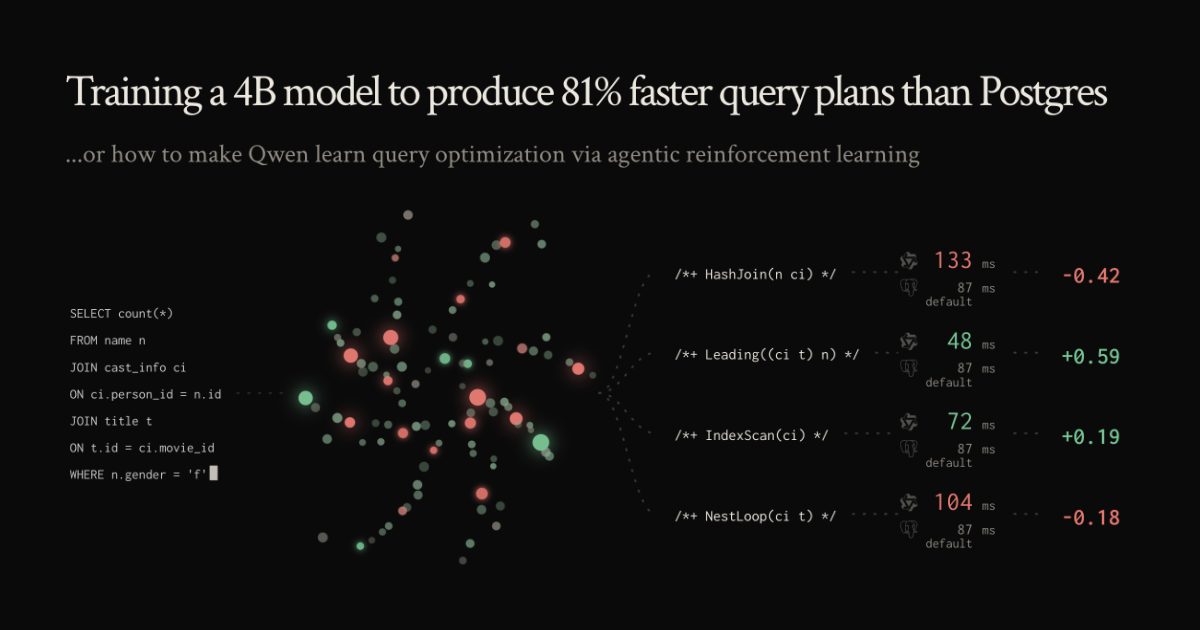
Leis et al. asked this exact question in 2015. Then, they asked it again 10 years later.
Despite an enormous body of research spanning a decade since their original exploration, they found that query optimizers continue to leave much to be desired.
I was surprised when I first learned about this. A Postgres database should know everything about the stuff that lives in its tables, no? How hard can it be?
As it turns out: enormously hard. In fact, one particular task a query optimizer needs to do, join ordering, is known to be NP-hard.
So query optimizers are hard. What’s not as hard is verifying whether a query plan an optimizer picks is good or not. Put simply, a good query optimizer produces plans that run fast, and a bad one produces slow plans. Language models are particularly good at learning how to do tasks with easily verifiable outputs. Because there’s a single axis to optimize for—execution time of a query—the problem beautifully reduces to reinforcing the behaviors that guide a model to produce faster query plans.
What follows is a breakdown of an experiment I ran to explore the question: can a small, open-weights model be post-trained via supervised fine-tuning (SFT) and agentic reinforcement learning (RL) to produce Postgres query plans that beat Postgres’s default plans?
The answer to our question is a resounding yes. Highlights include:
Let’s say I’m trying to answer the question: “Which Japanese companies put out the most titles in the 2000s?” We might write the following query:
Running this query outputs 10 Japanese companies with the number of titles they were associated with between 2000 and 2009, sorted from highest to lowest.
The path Postgres took to get this data for us is not a foregone conclusion, and it has everything to do with what we call selective predicates (i.e. the filtering conditions in a WHERE clause).