// HACKER NEWS — CYBERSECURITY
Made by Mechanical Means
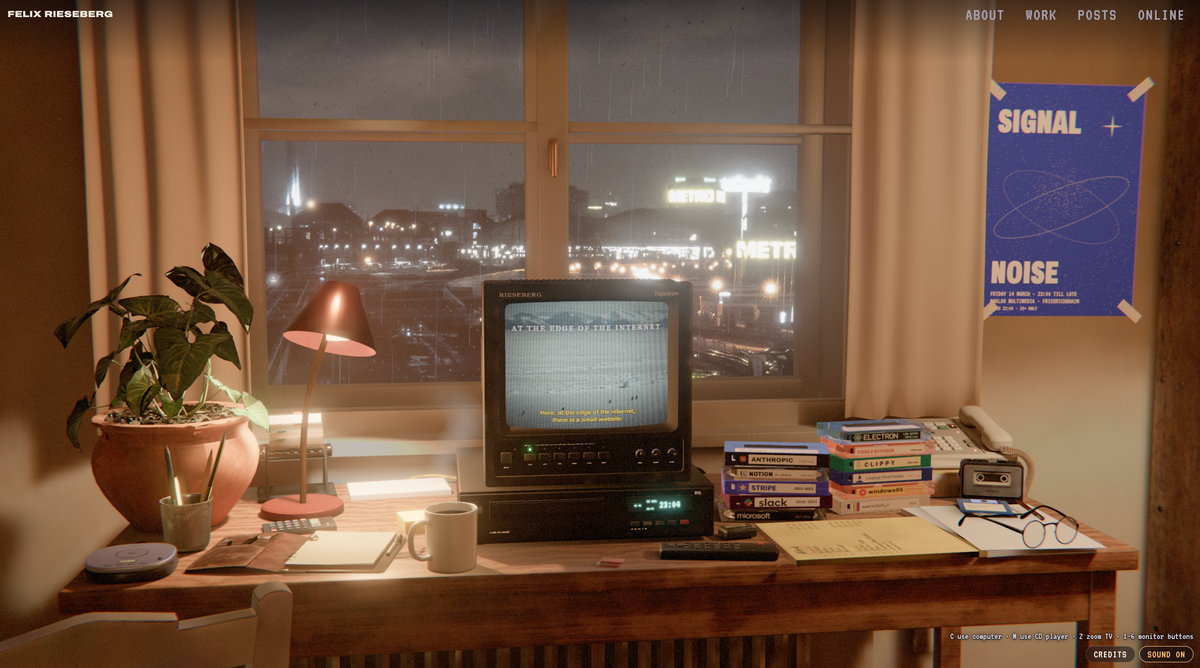
One notable difference between working on Claude and the other productivity tools I've touched is that feature requests are surprisingly not the #1 discussion topic. Instead, people want to know how I'm using Claude, how they should be using Claude, and whether there are any cool magic spells I can share.
In this post, I'd like to walk you through the process of redesigning my homepage without touching or running code or even using traditional Claude Code. No PRs were made, nor did I open GitHub. If you haven't seen the full end result, maybe check it out first.
Roughly 60 threads worked, often in parallel, on my increasingly outrageous requests, which included creating a CGI parody of a Werner Herzog documentary in Blender and synthesizing soundtracks from scratch. Despite the complexity, a considerable amount of that orchestration happened on my phone rather than my computer - in fact, I didn't have to run any code locally. Claude worked entirely in the cloud.
I'm writing this in late September 2026, and I suspect my workflow will look very different in six months. Even compared with the beginning of the year, I'm noticing a stark difference - my work is now a lot more creative, less bounded by the technologies I've mastered, and so much more visual and emotional. I've used Opus 5.5 for all the work.
I started by creating a new Claude Project. Projects are becoming a layer that spans Chat, Cowork, and Code; you can think of them as sitting above domain-specific concepts. You talk to one Claude with the ability to spin off additional sessions, share files and memory between them, and supervise the entire fleet of Claudes to achieve goals.
Earlier this year, I would have joked that I get a lot done by telling a bunch of Claudes to do work. Now, I've put one Claude in charge of each of my projects, and in turn, that Claude knows how to manage tasks, investigations, and threads. We're talking more about goals and less about how to achieve them.
Every thread gets its own computer in the cloud, where it installs whatever it needs (Blender, FFmpeg, Playwright), checks its work with screenshots from a headless browser, and publishes a private preview page for me to click through. All threads share one folder of files and one memory. Claude is smart enough to write down decisions I made in memory and makes sure newly started threads follow them without me having to repeat myself.
I started the way I'd start with a design team: by dumping a bunch of inspiration on the table. Those included 90s rave posters, movies I liked, ads that spoke to me, photos I keep coming back to, even just concepts I like.
Ten threads explored those directions in parallel with very little guidance. One came up with portfolio directions for somebody who really likes camping in national parks; another imagined what an 80s Ghost in the Shell website would look like. Both, it turned out, felt a little overdone to me. I wanted to make something new, not just clone something already out there.
Whenever I liked a direction, I asked Claude to double down, get creative, and give me five more variations of the same direction.