// HACKER NEWS — CYBERSECURITY
September 2026: The world today, as seen by one Polish guy
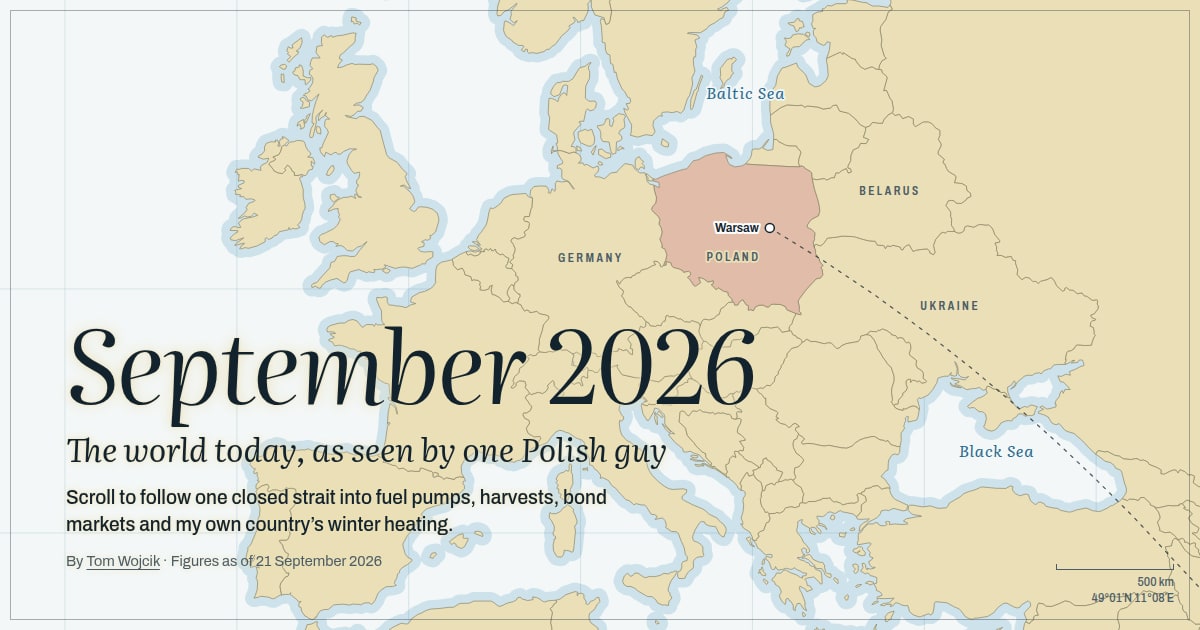
I am a Pole. My country borders Europe’s largest war since 1945, heats itself with coal and imported gas, and arms itself on borrowed money. From here the news does not arrive as separate stories.
Every generation believes it is living through the end of something. What is different in 2026 is that the crises have stopped arriving one at a time. A war in the Gulf becomes the price of my diesel, smaller harvests from Sudan to Yemen and a half-empty gas cavern in Bavaria.
The world is not ending. But for thirty years we swapped buffers for dependencies, because a supplier is cheaper than a stockpile and a guarantee is cheaper than an army. When a dependency failed, we did not rebuild the buffer. We found another dependency. Every swap worked for as long as the thing at the other end was there. This year, several of those things were tested together.
Start about 4,000 kilometres south-east of Warsaw. US and Israeli military operations against Iran began in late February. Since March, Iran has kept the Strait of Hormuz closed with drones, missiles, mines and small boats.
Tanker traffic through it has fallen by more than 90 percent. The International Energy Agency calls it the largest supply disruption the oil market has ever seen. What follows is that closure travelling in three directions at once: into fuel, into food and into this winter’s heating.
Markers on the chart open when you hover over or tap them.
A fragile ceasefire pulled prices back to pre-war levels in early summer, then broke down. By early September Brent crude was near $97 a barrel, up 19 percent in a month, by mid-month it was around $105, and on 24 September it touched $108.
On 22 September Iran handed Washington a written road map: a regional ceasefire of up to 60 days, a phased reopening of the strait and an end to the American naval blockade. Washington rejected it, and by one report the president expects to resume bombing after the November midterm elections.
The detour around the Gulf runs through the Red Sea’s own chokepoint, the Bab al-Mandab, where Houthi forces seized a key Yemeni port this month.
A chart doing the rounds on investing forums this month shows a tanker-shipping fund going parabolic. It is real. The Breakwave Tanker Shipping ETF, which tracks the cost of hiring a crude tanker, rose more than 600 percent in the first two months of the war and was up more than 2,300 percent for the year by early September. Day rates for some supertankers went from under $100,000 before the war to a record of about $860,000 on 10 September.