// NATURE NEWS — SPAZIO & SCIENZA
Can pancreatic cancer be stopped in its tracks? Radical tactic raises hopes
Heidi Ledford reports for Nature from Seattle, Washington.
Search author on:
PubMed
Google Scholar
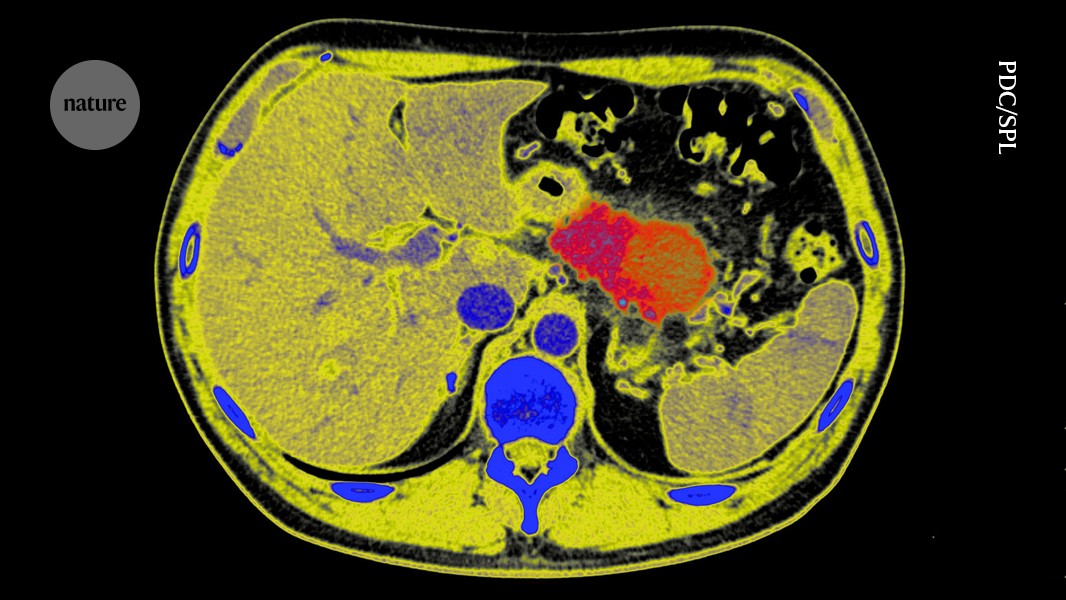
Early detection of pancreatic cancer (red; artificially coloured) could help to improve the survival rates of a highly lethal disease.Credit: PDC/SPL
Armed with new tools and fresh optimism, researchers seeking to subdue pancreatic cancer — one of the world’s deadliest — are chasing a radical strategy: cancer interception.
In this approach, tissues that are growing abnormally are treated to keep them from turning cancerous and spreading. Interception is already being trialled for breast and skin cancers, among others. But now the success of a new drug that quashes pancreatic tumours is raising scientists’ hopes that interception could succeed even for this recalcitrant cancer.
CRISPR makes enhanced cancer-fighting immune cells inside mice
Cancer interception was one of the main themes at last week’s American Association for Cancer Research Conference (AACR) on Pancreatic Cancer in San Diego, California — the first such meeting since the US Food and Drug Administration approved the landmark pancreatic-cancer drug daraxonrasib (Rasonque) in August. Its success has renewed optimism that researchers can combine it or other emerging therapies with early-detection methods to revolutionize how pancreatic tumours are treated.
A combination of early-detection techniques and interception is “going to be the breakthrough strategy that really changes survival”, says Diane Simeone, director of the Moores Cancer Center at University of California San Diego Health. At the AACR meeting, Simeone argued that such an approach could more than triple the proportion of people who survive for five years after being diagnosed with pancreatic cancer, from 13.7% to 50%.
It’s a lofty aspiration, but other researchers are also eyeing interception. “We’re so excited that we are at this juncture now to even be considering this,” says Anirban Maitra, director of the Perlmutter Cancer Center at New York University Langone Health in New York City. “This wasn’t possible even a few years ago.”
Pancreatic tumours are notoriously wily: they are often highly invasive, impervious to most treatments and can wrap themselves around major arteries and veins, making the growths difficult to remove.