// SPACE.COM — SPAZIO & SCIENZA
Japan's Hayabusa2 probe captures remarkable photo of a two-headed asteroid 62 million miles away
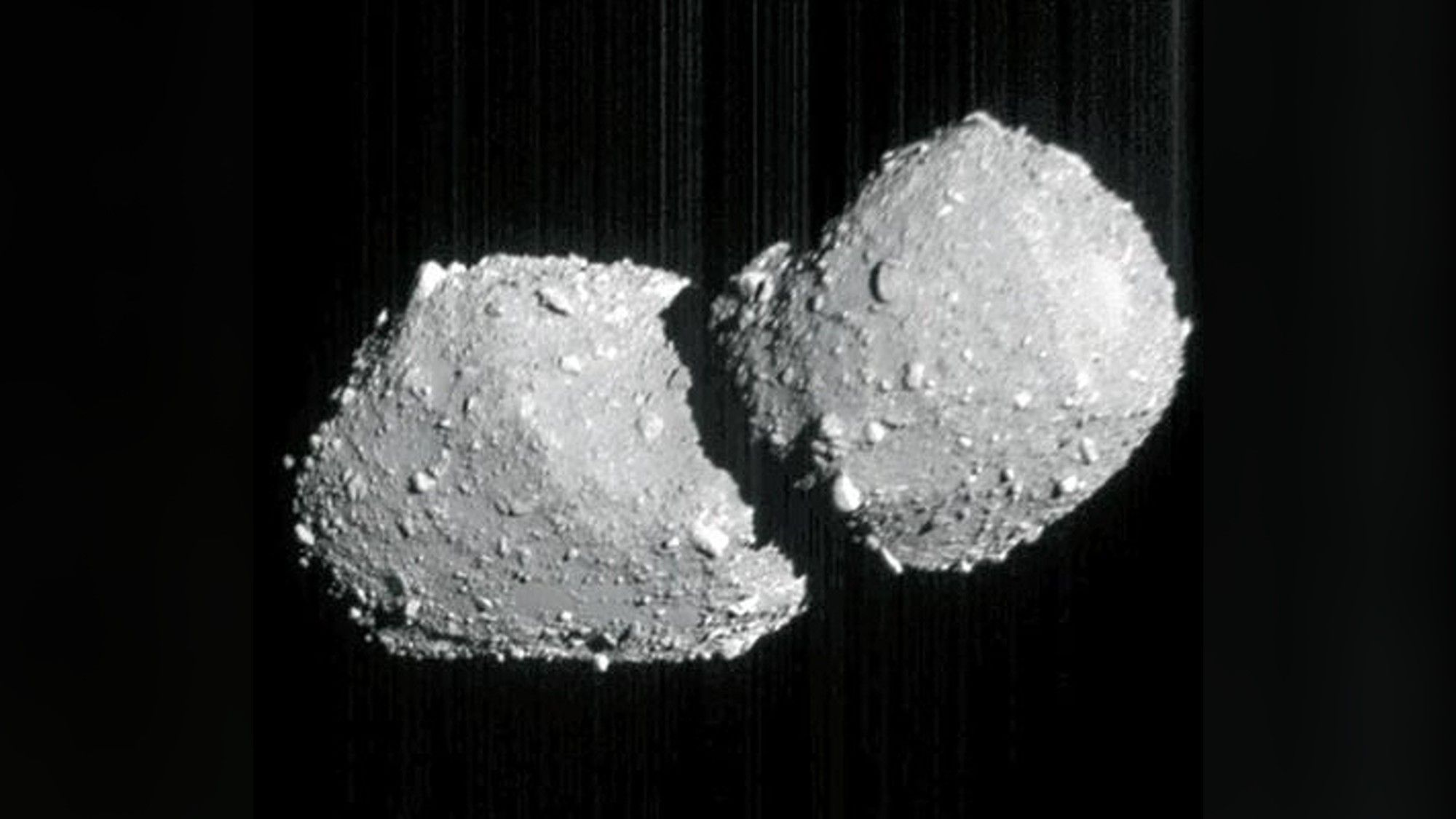
The spacecraft that famously brought asteroid Ryugu samples to Earth in 2020 has flown right by another space rock.
When you purchase through links on our site, we may earn an affiliate commission. Here’s how it works.
A Japanese spacecraft has gotten up close and personal with yet another asteroid, beaming home stunning new imagery of the distant space rock.
On Sunday (July 5), the Japan Aerospace Exploration Agency (JAXA)'s Hayabusa2 probe performed a close flyby of asteroid Torifune, a 1,475-foot (450-meter) space rock currently traveling through space some 62 million miles (100 million kilometers) from Earth. It was expected to be one of the closest-ever high-speed passes a spacecraft has had with an asteroid.
During the flyby, Hayabusa2 captured this breathtaking new image of Torifune using its optical camera, and was able to transmit it back to JAXA controllers. The probe captured additional scientific data about the asteroid, but will beam those results home at a later date, according to JAXA.
Hayabusa2 also imaged asteroid Torifune using its Mid-Infrared Camera (TIR), which allows scientists to measure asteroids' surface temperatures, thermal inertia and surface roughness, according to JAXA. This mid-infrared image reveals Torifune to be much cooler in what appear to be shadowed regions seen in the optical image, and much warmer where the surface faces the sun.
Torifune orbits the sun every 383 days and rotates every 5 hours. It belongs to the Apollo group, a classification of near-Earth asteroids whose orbits cross Earth's as they make their way around the sun.
Hayabusa2's flyby of Torifune was not part of its original mission, and one of the members of the probe's scientific team previously told Space.com the flyby was a "risky operation" due to the unknowns surrounding the asteroid.
These new images add to the growing list of incredible accomplishments the Hayabusa2 probe has notched on its now nearly 12-year mission.
Hayabusa2 launched in December 2014 on an ambitious mission to collect asteroid samples and return them back to Earth. The probe did just that in December 2020 when JAXA successfully landed samples of asteroid Ryugu in the Australian desert.