// NATURE NEWS — SPAZIO & SCIENZA
Prehistoric global migration of vanishing gut microbes with humans
Nature
(2026) Cite this article
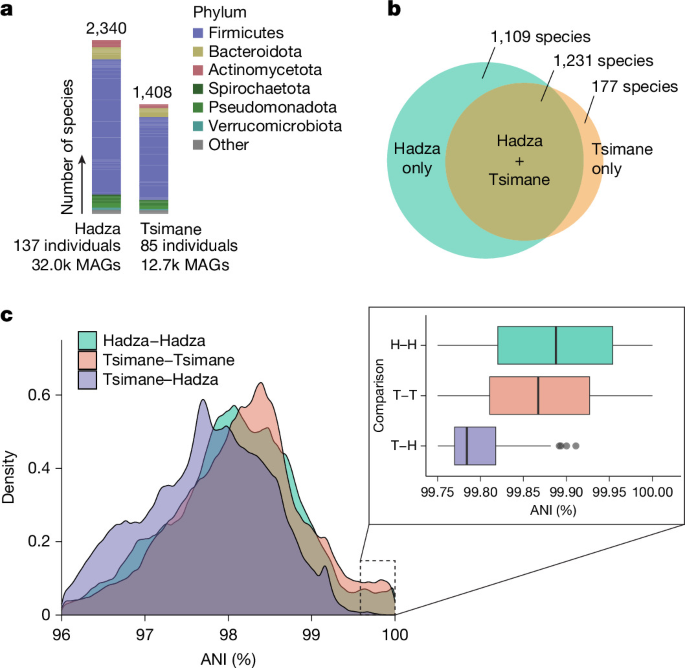
The gut microbiome is crucial for health and is affected strongly by lifestyle1. Many microorganisms commonly found in non-industrialized populations are disappearing or have become extinct in industrialized populations2,3,4,5,6. Studying which microorganisms have been long-term residents of the human gut and may have co-evolved with humans2,7,8 could provide insights into how microbial biodiversity loss affects human health. However, the genetic complexities of microbial evolution and the plasticity of gut microbiome composition have made it challenging to resolve the evolutionary history of these long-term associations. Here we performed deep metagenomic sequencing of the Tsimane horticulturalists of Bolivia and compared their gut microbiomes with those of the Hadza hunter-gatherers of Tanzania3. These two populations, whose ancestors have been separated for tens of thousands of years, share 1,231 microbial species, most of which are rare in or absent from industrialized populations. Population genetic analyses of 636 of the shared species revealed patterns of microbial divergence and gene flow consistent with prehistoric human co-migration, with estimated split times that approximately align with human migration out of Africa and into the Americas. Our findings indicate that a diverse gut microbiome co-migrated with humans worldwide and has persisted over millennia. However, many of these species are now vanishing from industrialized populations and the consequences for human health remain uncertain.
Commensal gut bacteria play a complex part in human biology1, but the evolutionary history of these microbial relationships remains poorly characterized9. Identifying long-term associations between humans and microorganisms is important for understanding their co-evolution7,10,11, and this could reveal microbial species and functions integral to human health and physiology.
Direct observations of historical microbial relationships have been obtained by sequencing palaeofaeces12. This study suggested that ancient gut microbiomes were more similar to those of contemporary non-industrialized populations than to those of industrialized ones (the term industrialized here refers to post-industrial populations as well as those in advanced and ongoing stages of industrialization). However, the comparatively recent ages of existing palaeofaeces (around 1,000–2,000 years old), combined with the challenges of analysing degraded ancient DNA, makes it difficult to determine whether these microbial lineages have been faithfully transmitted over long evolutionary timescales (of around 10,000–100,000 years) or were acquired or transmitted more recently.
Comparative genomics methods provide an alternative approach to inferring evolutionary history from the patterns of genetic diversity among contemporary microbial genomes8,13,14,15,16,17,18,19. Building on previous work in non-human primates2,8,19,20,21, advances in strain-resolved metagenomics have made it possible to use this approach on gut microbial species sampled from human populations worldwide. Previous work has identified phylogenetic correlations between gut microbial genomes and their human populations of origin7, potentially consistent with long-term associations18,22,23. However, interpreting these correlations remains challenging because they require genome comparisons at the subspecies, or strain, level. Conventional phylogenetic methods24 often fail in such settings because intra-species gene transfer and homologous recombination between strains produce mosaic patterns of ancestry that cannot be represented by a single phylogenetic tree25,26,27,28. These high rates of recombination make it difficult to distinguish ancient co-migration from other sources of population structure, such as geography or host lifestyle variation22,23. Moreover, existing strain-level analyses have been biased towards gut microbial species