// NATURE NEWS — SPAZIO & SCIENZA
Daily briefing: Physics Nobel for founder of neutrino-hunting observatory
Search author on:
PubMed
Google Scholar
Hello Nature readers, would you like to get this Briefing in your inbox free every day? Sign up here.
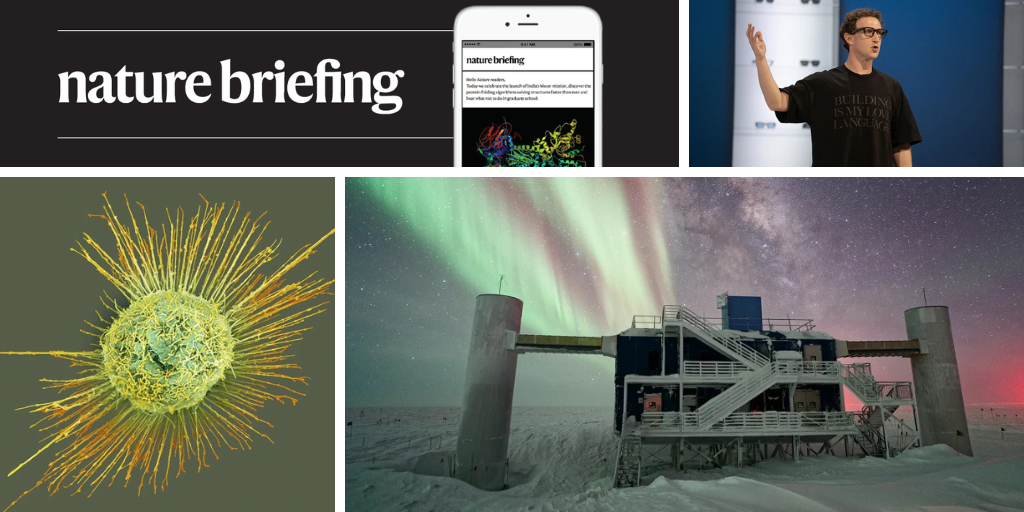
The IceCube Neutrino Observatory building sits above a vast cubic-kilometre array of photo detectors buried deep below the ice. (Ilya Bodo, IceCube/NSF)
Physicist Francis Halzen has won the 2026 Nobel Prize in Physics for his work in founding the IceCube Neutrino Observatory and for the discovery of high-energy neutrinos that come from deep in space. More than 1 billion neutrinos pass through your hand every second, but they are hard to detect because they are unaffected by magnetic fields and rarely ever interact with matter. IceCube detects once-in-a-blue-moon interactions between atoms and neutrinos that have been emitted by cosmic events such as supernovae and γ-ray bursts. “This reflects on the really courageous people who joined me in this project”, Halzen said, “when really no respectable conservative physicist would have joined me.”
After decades of planning and construction, “there was no guarantee we would ever see anything”, said Halzen. But it took only two years for the collaboration to detect particles from outside our Solar System, establishing the new field of neutrino astronomy.
Francis Halzen’s essay ‘Antarctic Dreams’, about IceCube’s precursor, the Antarctic Muon And Neutrino Detector Array, was featured in The Best American Science Writing 2000. In it, he says that, as a “superfluous theorist”, he has never made the journey to see his project in person. “But even now, on the nights when drilling goes on there, I can never sleep,” he writes. “To have your career on the line half a world away is hard enough. But to know that you have embroiled so many others in the same improbable adventure, that your funders and colleagues expect results, and that you are totally powerless to affect the outcome, is a form of exquisite torture.”
Neutrinos are cool — that’s the first reason I’m so excited about this Nobel. When the Nobel committee made its announcement, several physics folk in our team grinned at each other. And I’d go so far as to put my money on neutrinos being the thing that finally breaks open the standard model of particle physics. The simplest version of the model says that neutrinos have no mass, but experiments show they do — we just don’t know exactly what it is. Or whether they are their own antiparticles, or if they have something to do with the great mystery of why there’s more matter than antimatter. IceCube’s purpose isn’t to study neutrinos themselves, but it has revealed more about them — such as how they interact with matter. Understanding neutrinos could mean understanding the Universe — whether that’s through IceCube’s successor, or one of the many other experiments racing to probe this particle du jour.
“Theorists write two kinds of papers. One kind to explore the physics they really believe in, and another kind just to show how smart they are. And my initial neutrino papers were certainly in the second category. I had never any intention of ending up doing this, but then things got out of hand.”
Francis Halzen says that being “naive and ignorant” when he started working on the proposal for IceCube helped him to succeed, because he didn’t know all the ways that it could fail. (Jot Down | 28 min read, from 2014, free registration required)
Flu season might have come earlier than expected in the Northern Hemisphere, with the percentage of positive influenza tests in places such as the United Kingdom and west coast of the United States unusually high for this time of year. “An early start doesn’t necessarily mean a more severe season,” says epidemiologist James Hay. But it could prompt a rethink of when people should get their annual vaccines. Specialists are also concerned that the subtype responsible for most US cases so far, H1N1, is carrying a mutation that could h