// ARS TECHNICA — MOBILE & WEB
Neanderthal wooden tools from Spain found preserved in stone
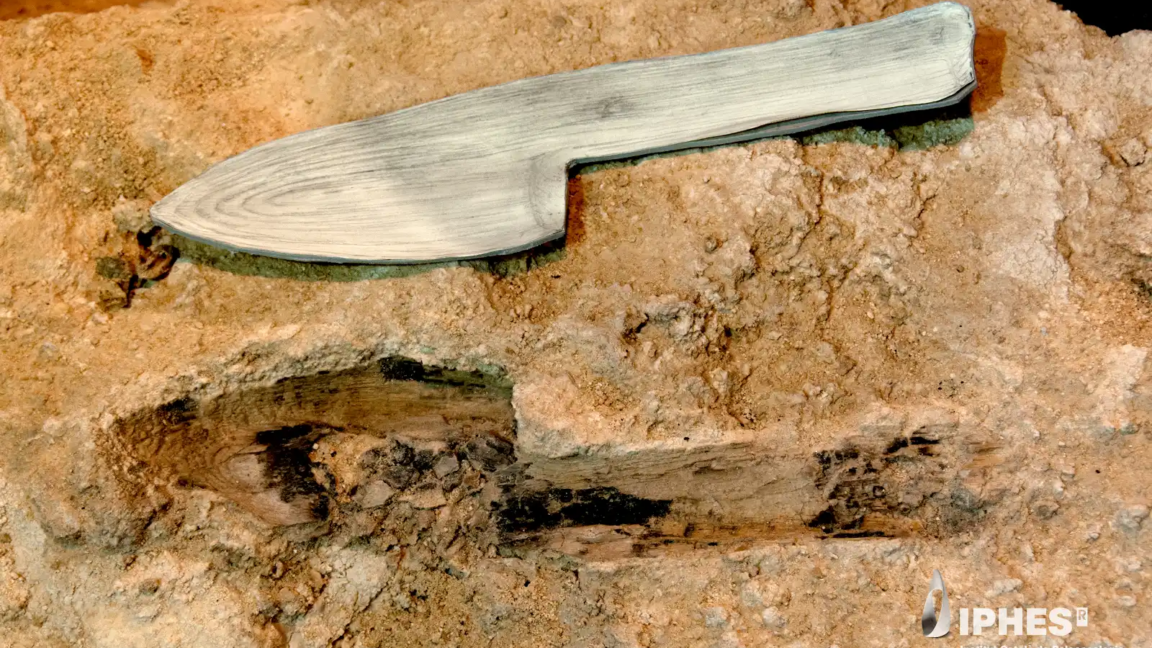
Dissolved rock precipitated around the tools, which then decayed.
The Stone Age owes its name to tools that survived to our time. The material early humans worked with most, though, was probably wood because it is so much easier to process. Unfortunately, we know very little about Paleolithic woodwork because wood rots relatively quickly. But at Abric Romaní, a rock shelter in Capellades, west of Barcelona, mineral-rich water coated wooden Neanderthal tools in a limestone-like crust. When wood rotted away, it left behind hollow molds that faithfully reflect its shape.
In a recent Science Advances study, a team of Spanish archaeologists has cataloged 597 wooden remains from Neanderthal living areas dating from 62,000 to 40,000 years ago. They found spears, digging sticks, bark trays, parts of shelters, and a club unlike anything seen before, suggesting Neanderthals were likely much more than just Homo sapiens’ dumber cousins.
The oldest wooden artifacts we have are mostly weapons. They include spears from a German town called Schöningen, a spear tip from Clacton-on-Sea in England, and the spear found alongside an elephant skeleton in Lehringen, Germany. Most came from waterlogged sediments, where a lack of oxygen slowed decay.
The spears mostly give us information about how Neanderthals hunted. The findings at Abric Romaní are different because the finds come from a place where Neanderthals lived, slept, cooked, and made tools over the course of some 20,000 years.
“We have a sample of wooden tools for different subsistence activities, not only hunting,” says M. Gema Chacón, an archaeologist at the Catalan Institute of Human Paleoecology and Social Evolution (IPHES-CERCA) and co-author of the study. Because wood turns up in level after level, it shows that woodworking was routine for Neanderthals rather than an occasional one-off.
The shelter sits at the foot of a cliff of travertine, a limestone laid down by calcium-rich spring water. As that water dripped across the shelter floor, calcium carbonate settled on anything lying around—logs, leaves, pine cones, and Neanderthal tools. Sealed inside the crust, the wood slowly decomposed, leaving hollow molds. These are perfect negatives of the original objects, sometimes so detailed that the outlines of wood cells are visible under a microscope.
Abric Romaní has been explored continuously since 1983, so the team has had time to develop a method for excavating objects that are essentially empty space. Each find is outlined, mapped, and photographed, and restoration specialists consolidate the fragile crust. “Then we open very carefully one part of the object,” Chacón explains.
In the past, the team filled the hollows with resin or plaster to get a positive cast. “Now all the wooden remains are printed in 3D,” Chacón says. The molds are digitized with 3D scanning and photogrammetry, and the 3D-printed copies are used both for research and museum displays.
Most of the 597 remains turned out to be natural trunks, fallen branches, and lots of firewood, mostly Scots pine. Only 13 objects were made or modified by Neanderthals. “The morphology of these 13 tools is impossible to find in nature,” says Chacón.