// NATURE NEWS — SPAZIO & SCIENZA
Daily briefing: Rogue ‘jumping genes’ age bigs dogs faster than little ones
Search author on:
PubMed
Google Scholar
Hello Nature readers, would you like to get this Briefing in your inbox free every day? Sign up here.
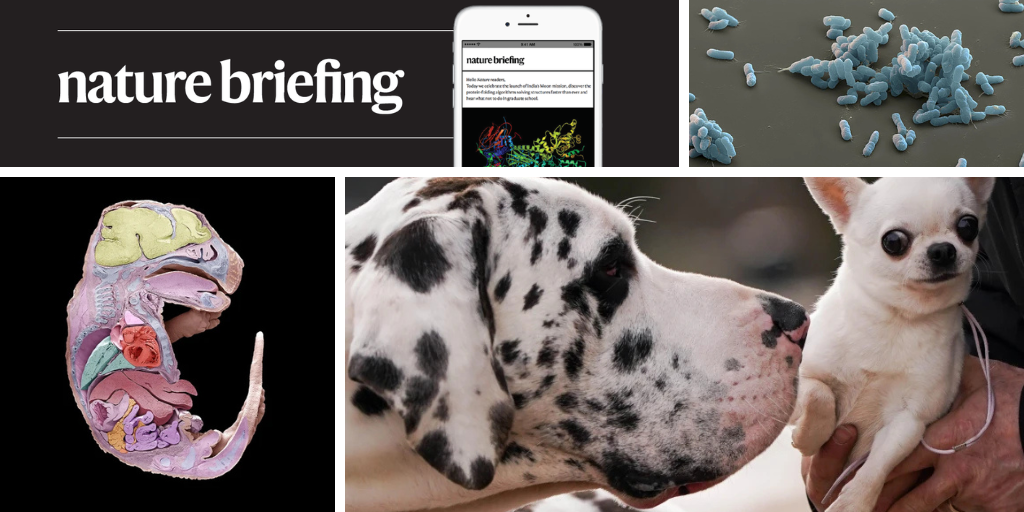
Just you wait: big dogs tend to age more quickly than small ones, which might be attributed to differences in the chemical tagging of the genome.Credit: Jacob King/PA Images/Alamy
Large dog breeds tend to age more quickly than small ones, possibly because they have more ‘jumping genes’ moving around their genomes. In a study of nearly 900 dogs representing about 120 breeds, researchers found that ageing in dogs is accompanied by changes in certain chemical groups added onto DNA that can control gene activity. In big dogs, these epigenetic changes accumulate at a faster rate, and some appear to enable jumping genes to hop into a new location on the genome and disrupt normal genes.
The death of a 28-year-old researcher at a Siberian laboratory, possibly from pneumonic plague, has triggered international alarm over whether the incident could spark a wider outbreak. The chances of that are low, and there’s no evidence that links the lab to bioweapons research in Russia, say biosecurity experts, but the lack of transparency around the incident is concerning. “The World Health Organization can’t force anybody to give them information; they can just ask politely,” says biosecurity-policy specialist Gregory Koblentz. Open-source biosurveillance systems are only so helpful “when you have a government that is secretive by nature and refuses to share information,” he says.
Two independent research teams have released ‘cell recorders’ based on gene editing that capture the development of mouse embryos in unprecedented detail. One team recorded the cell-by-cell development of a two-week-old embryo from a single fertilized egg, and the other captured most of the cell divisions in embryos as organs formed. The trackers are the first to trace the lineage of cells in a mammal, inspired by a map of the nematode Caenorhabditis elegans — still the only full map of animal development.
• On Monday, the 2026 Nobel Prize in Physiology or Medicine was awarded to Karl Deisseroth, Peter Hegemann and Georg Nagel for their work in optogenetics — a technology that allows researchers to control the brain’s neurons with pulses of light. (Nature | 8 min read) Learn about optogenetics from laureate Karl Deisseroth himself in this video lecture from 2013. (iBiology | 38 min watch)
• Physicist Francis Halzen won the Physics Prize on Tuesday for his work in founding the IceCube Neutrino Observatory and for the discovery of high-energy neutrinos that come from deep in space. In a 2014 interview, he advised students: “don’t read too many books, do things!” (Jot Down | 28 min read, free registration required)
• Chemists Henri Kagan and Kenso Soai won this year’s Nobel Prize in Chemistry on Wednesday for their work on a long-standing mystery: how can living organisms create molecules that are just one of two possible mirror-image variants? (Nature | 5 min read)
The academies that award the Nobel prizes say they have applied themselves to doing a better job of recognizing the accomplishments of female scientists, but this year’s science laureates did not include a single woman. Here’s a game to test your expertise about past winners: can you name the women who have won a science Nobel prize?