// NATURE NEWS — SPAZIO & SCIENZA
China’s extraordinary rise in science and how it will change the world
Search author on:
PubMed
Google Scholar
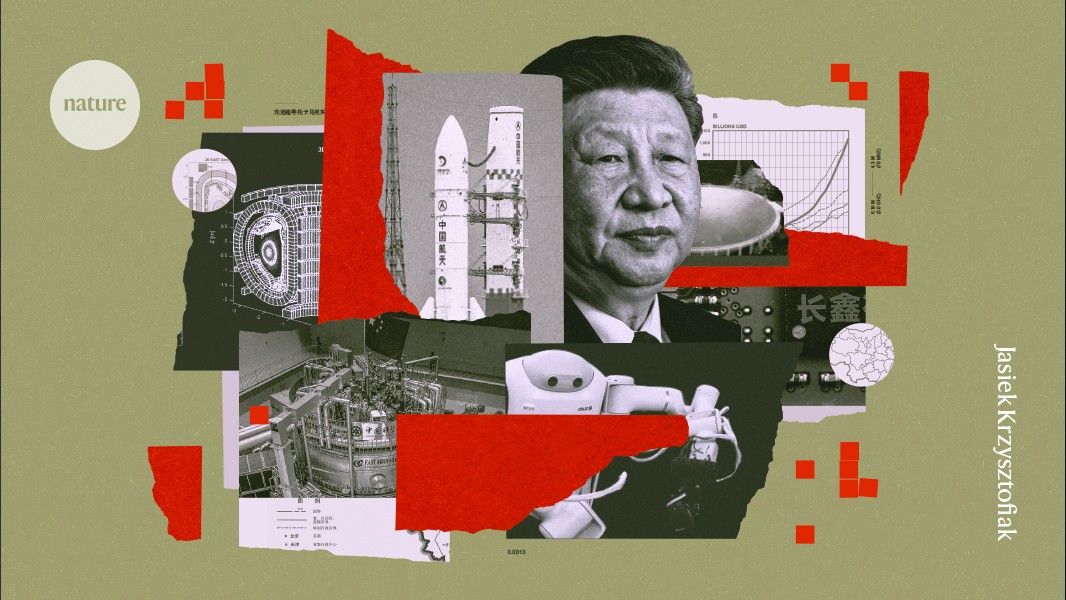
Illustration: Jasiek Krzysztofiak. Photos: Qilai Shen/Bloomberg/Getty; Shawn Thew/EPA/Bloomberg/Getty; AFP via Getty; Inst. Plasma Physics at Hefei Insts of Phys. Sci., Chinese Academy of Sciences; S. L. Chen et al./Sci. Rep. (CC BY 4.0); VCG via Getty(2)
China’s President Xi Jinping is betting big on science. At a high-level meeting in Shanghai in April, he urged regional governments, universities and research institutes to strengthen the country’s fundamental research.
“We must seize opportunities, rise to challenges, put basic research high on the agenda,” he said.
Xi’s directive is part of a broad and long campaign by China to up its game in science and technology. Just a month earlier, the country’s leaders highlighted the importance of science in China’s latest five-year plan.
That policy blueprint calls for substantial investments in fundamental research and innovation, and pledges to accelerate the development of frontier technologies, such as artificial intelligence, quantum applications and controlled nuclear fusion, by the end of this decade.
China’s AI research is booming. Where is it headed?
The fundamental-research push is China’s latest effort to grow its scientific and technological might — a campaign that started nearly 50 years ago and has accelerated drastically since 2000.
In 1978, when it opened itself to the world, China had almost no scientific presence on the global stage. Fewer than 120 scientific articles in international journals, or just 0.02% of the global total, were published by researchers in the country, according to Elsevier’s Scopus citation database.
But less than 50 years on, China has become a global scientific powerhouse and is on course to lead the world in research and development (R&D). Currently, it is one of the largest R&D spenders, leads in the number of patent applications and dominates research of dozens of crucial technologies, such as nuclear energy and synthetic biology. Its universities and institutes are rivalling conventional academic giants in the West and have topped the Nature Index chart for the first time.