// ITS FOSS — LINUX & OPEN SOURCE
This Dev Built an Office Suite Because His Wife Kept Going Back to Microsoft Office
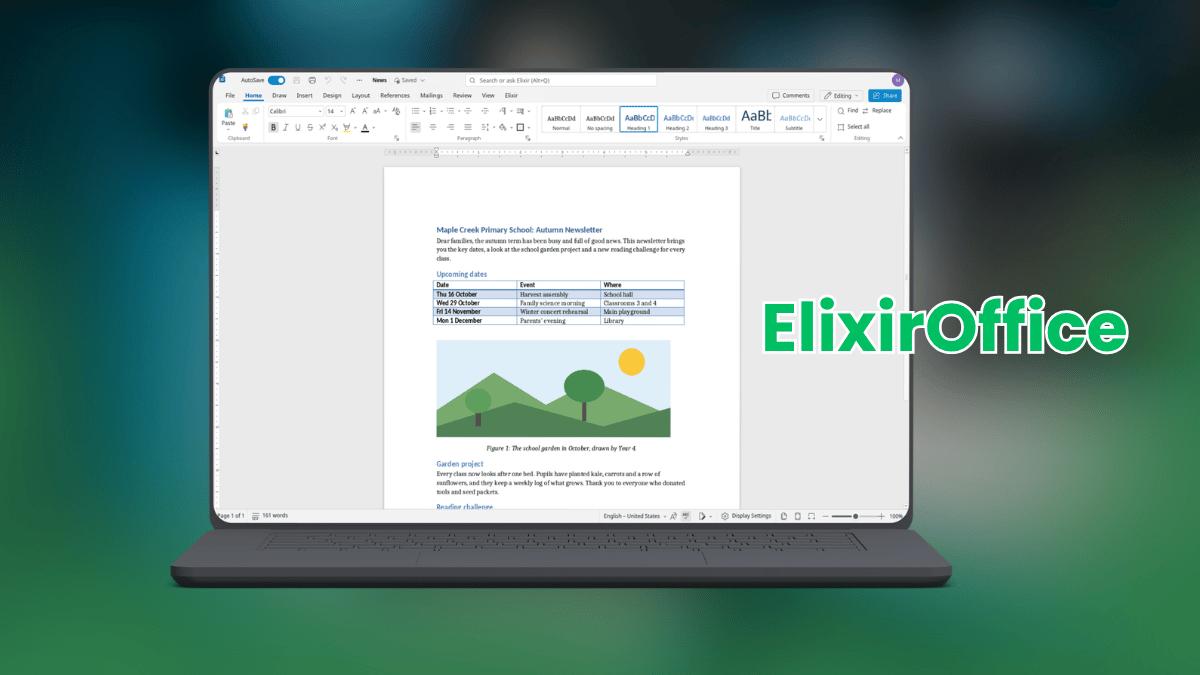
Gaël Duval has already put out two beta releases of ElixirOffice, a desktop app and a self-hosted server version, and he is asking early testers for feedback.
His wife, a teacher, has been facing a predicament many people usually face when using open source office suites. For her, the editors offered at school felt unfamiliar, the menu items and shortcuts felt out of place, and not to mention colleagues' documents also looked off.
ElixirOffice follows the Microsoft Office-style ribbon, menus, and shortcuts, and it opens OOXML document formats as well as their OpenDocument counterparts. It targets Linux, Windows, and macOS, with a server version aimed at teams.
Both of those versions use the AGPL-3.0 license, where the desktop app works offline, while the server version runs through Docker on a machine you host.
ElixirOffice offers substitutes for the usual Microsoft Office apps. The document editor takes the place of Word, the spreadsheet editor of Excel, and the presentation editor of PowerPoint.
Each one opens the Microsoft format and its OpenDocument equivalent, so .docx and .odt files go to the document editor, .xlsx and .ods to the spreadsheet editor, and .pptx and .odp to the presentation editor.
The server version also lets you connect Murena Workspace and Nextcloud accounts through an optional start page, which stays disabled unless you switch it on, and the desktop editor has no support for accounts, mail merge, co-editing, version history, or password-protected files.
On Linux, the desktop beta comes as an AppImage and a DEB for Debian and Ubuntu, whereas Windows gets an installer and macOS a disk image for Apple Silicon devices only.
Gaël started and supervised the project, while large language models handled the coding via AI agents, with tests and reviews being run on every change. ElixirOffice also has optional AI features that stay off until you connect a model of your own.
To keep layouts close to Word without Microsoft fonts, it ships free metric-compatible ones, plus Marelle, a font commissioned by the French Ministry of Education. The README file on the project's repo also claims that no telemetry is collected and sent.