// NATURE NEWS — SPAZIO & SCIENZA
Early tetrapod neck mobility modelled using an extant analogue
Nature
(2026) Cite this article
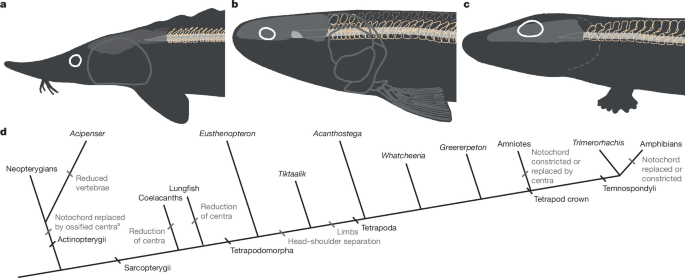
Tetrapods arose from lobe-finned fishes with a notochord-dominated axial column1,2,3. During this transition, the skull became separated from the shoulder girdle4,5,6, giving rise to a neck region. This head–shoulder separation has generated hypotheses suggesting that neck mobility increased during the origin of tetrapods, facilitating the ecological transition towards more terrestrial habitats4,5,7,8,9. However, incompletely co-ossified vertebral components10 have posed a challenge to modelling the mobility of these early tetrapod necks. Here we used material tests on the similarly configured axial columns of sturgeon to predict the capacities of the tetrapod neck region for lateral flexion, extension and rotation across the tetrapod stem. Our model indicates that the soft tissue-dominated axial column was surprisingly rigid, despite lacking co-ossified vertebral components. We estimate that most stem tetrapods could move their heads less than 6° laterally and less than 3° dorsally but could not rotate them. Notably, mobility did not shift in conjunction with the head–shoulder separation that occurred between the origin of tristichopterids (represented by Eusthenopteron) and that of more crownward stem tetrapods. Therefore, mobility in the tetrapod neck did not serve as a functional driver of head–shoulder separation. Instead, forelimb-driven locomotion, implicated in early tetrapods11,12,13,14, provides a better functional explanation for the head–shoulder separation.
Since the head and trunk first became anatomically distinct in the earliest vertebrates, the interface between these two body regions has undergone a series of evolutionary transformations3,5,9,15. These include a distinct vagal neural crest population16,17,18,19, neck musculature (that is, cucullaris)20,21,22, specialized anterior spinal nerves (the accessory and hypoglossal nerves)23,24,25 and shoulder girdle6,15,26,27. During all these transformations, full head motion (as opposed to intracranial motion) was never independent of trunk motion5,6,9,28,29. However, the skull–trunk linkage underwent a marked change during the origin of tetrapods when the skull and shoulder girdle separated, giving rise to a distinct neck region unique to tetrapods1,5,6. Documented in key stem tetrapods such as Acanthostega4,8 and Tiktaalik9, this head–shoulder separation has given rise to the hypothesis that neck mobility increased markedly through an increase in flexion, extension or rotation across the new neck region during the origin of tetrapods as they began to inhabit more terrestrial habitats4,7,8,9. The predicted increase in neck mobility has not been functionally tested.
Stem tetrapods have an axial column dominated by the soft tissue notochord, which they retain throughout adulthood1,2,3,30,31 (Fig. 1). The notochord is surrounded by distinct cartilaginous or bony arches that lack bone-to-bone joints32,33 (Fig. 1b,c and Extended Data Fig. 1). This condition predates the evolution of the vertebral column characteristic of most adult crown tetrapods in which the notochord is mostly replaced by bony centra. In such an axial column, each vertebral centrum is generally fused to a neural arch, and the vertebrae articulate with one another through inter-central and zygapophyseal joints10. Stem tetrapods lack these stiffening features, despite their hypothesized functional advantage in supporting the axial column for survival in increasingly terrestrial habitats4,7,8,9. These anatomical differences mean that the axial columns of stem tetrapods are not a joint-based system like those of crown tetrapods, making the ‘soft’ axial columns of stem tetrapods challenging to model. No modern tetrapods have an anatomically or functionally comparable axial skeleton10. To generate constrained estimates of the functional capability of the stem tetrapod neck, we sought an alternative model using phylogenetically independent bu