// NATURE NEWS — SPAZIO & SCIENZA
A microexon regulatory code reveals autism-linked genetic variation
Nature
(2026) Cite this article
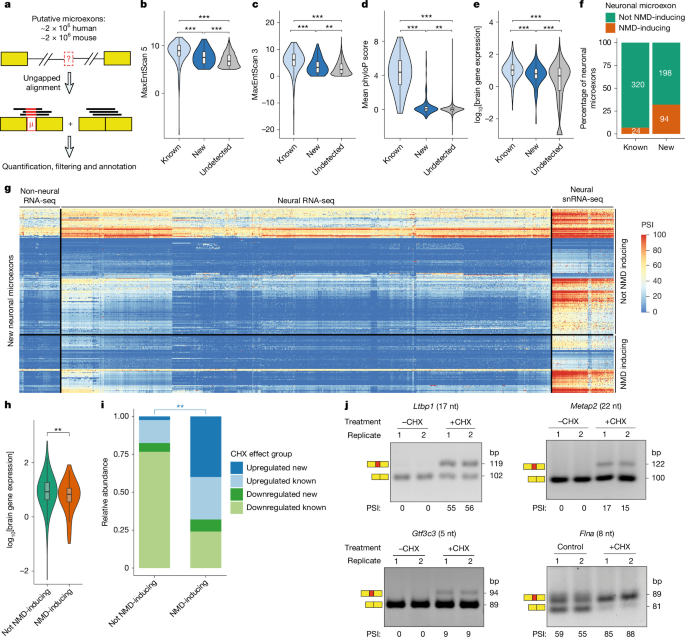
Neuronal microexons are a highly conserved class of alternative splicing events enriched in genes with critical functions in nervous system biology1,2. Microexon splicing is often disrupted in the brains of autistic individuals, and mice with microexon deficiencies display autism-like phenotypes1,3,4. However, the full landscape of microexons is not known, and the impact of genetic variation on these exons has not been systematically investigated. Here, through extensive transcriptome profiling, we detect hundreds of new microexons, including many with neuronal subtype-specific splicing patterns, and others that activate nonsense-mediated mRNA decay. Using machine learning, we define a sequence code predictive of neuronally spliced microexons and use this to identify critical regulatory elements surrounding the expanded microexon repertoire. This code further reveals genomic variants predicted to alter microexon splicing in individuals affected by autism, with rare variants having the strongest estimated impact. These variants are mostly detected in idiopathic individuals and are associated with autism status. They also converge on synaptic and other autism-linked genes, as well as genes not previously linked to autism. Our results collectively define an expanded repertoire of microexons, delineate their regulatory code, and pinpoint variants predicted to affect their splicing, with implications for the disruption of functions central to neuronal biology and brain disorders.
Autism spectrum disorder (ASD) is a highly heterogeneous condition. Common characteristics of affected individuals include altered social and communication abilities, and repetitive behaviours. Hundreds of genetic alterations have been linked to ASD5,6, and approximately 130 genes have been confidently associated with ASD susceptibility, with functions that converge on transcriptional and chromatin regulation, synaptic signalling and translational control7,8,9. However, high-confidence ASD-associated variants are detected in only around 15% of affected individuals. Among the approximately 85% of idiopathic individuals, missing genetic aetiology may be attributable, in part, to variants overlapping non-coding genomic regions with important yet difficult-to-predict functions10.
Alternative splicing, a critical process by which exon and intron sequences are differentially included in transcripts to generate functional and regulatory diversity, is widespread in the mammalian nervous system11,12. Neuronally enriched, 3–27-nucleotide-long microexons represent a highly conserved class of alternative splicing1,2. Most annotated microexons preserve reading frames, and characterized examples function in modulating protein–protein interactions required for nervous system development and function3,4. Consistently, mice haploinsufficient of the major activator of neuronal microexons, Srrm4, display autistic-like neuroanatomical, electrophysiological and behavioural features13. Moreover, perturbations of individual microexons also display ASD-related transcriptomic, neurodevelopmental and behavioural phenotypes3,4,14,15,16,17.
Transcriptome-wide profiling of post-mortem brain samples from ASD-affected individuals has revealed recurring, distinct patterns of altered gene and splice isoform changes18,19,20, with the most prominent splicing dysregulation affecting microexons1. This dysregulation may arise in part through factors that affect neuronal activity, as the altered transcriptomic patterns correlate with those detected in activity-stimulated neural cells13,19. However, whether and to what extent microexon splicing is directly affected by human genetic variation linked to neurodevelopmental disorders is not understood. Moreover, the extent to which microexons remain undetected is unclear, as previous studies focused primarily on analysing RNA-sequencing (RNA-seq) data from intact brain tissues, potenti