// NATURE NEWS — SPAZIO & SCIENZA
Lessons from Katrina: how to rebuild academia from the ground up
Laura Woodrow is a freelance writer in London and editor of Nature Briefing: Translational Research.
Search author on:
PubMed
Google Scholar
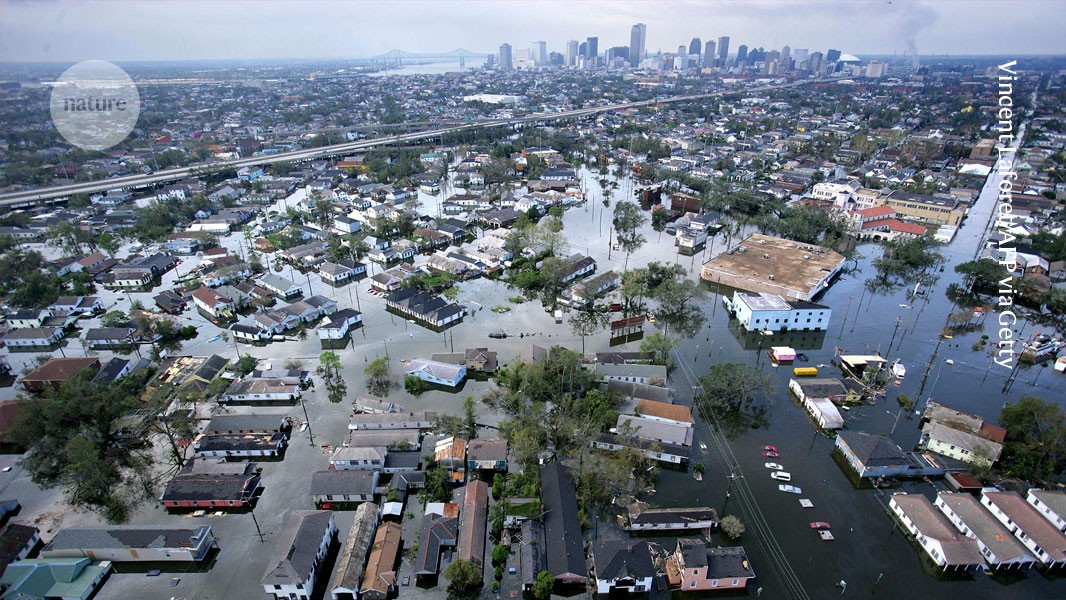
Flooding damaged and destroyed large areas of New Orleans, Louisiana, but lessons can be learnt from the city’s recovery efforts. Credit: Vincent Laforet/AFP via Getty
On 29 August 2005, Hurricane Katrina made landfall in southeast Louisiana as a Category 3 storm, with sustained winds of 205 kilometres per hour and a storm surge reaching between 4.6 and 5.8 metres in eastern New Orleans. The storm remains one of the deadliest ever to hit the United States, with millions of people displaced and more than 1,800 killed in the hurricane and ensuing floods. By 31 August, around 80% of New Orleans — the most affected city — was underwater.
Katrina had a profound impact city-wide, causing $17 billion in damages in Orleans Parish — the local county — alone. The burden of damage and the recovery efforts that followed fell unevenly. Environmental-justice scholars, such as Robert Bullard at Texas Southern University in Houston, argue that disasters are not great levellers, but follow lines of inequity that are already written into a city.
The academic sector suffered with the city. All ten of the main colleges and universities in the metropolitan area were affected. Some 84,000 students and 15,000 faculty members were displaced. Louisiana’s public universities collectively sustained between US$500 million and $600 million in physical damage, lost more than $150 million in tuition fees and revenue and faced $75 million in immediate budget cuts.
More than two decades on, the picture across the academic sector mirrors that of New Orleans as a whole: an uneven but impressive recovery. The reasons for divergence provide lessons for other institutions around the world looking to rebuild after a disaster.
● Recovery takes patience: plans must span several years.
● Lean on the wider academic community: networks are invaluable to support students and staff.
● Prioritize people: academia is a small part of a larger society that is working to recover.