// NATURE NEWS — SPAZIO & SCIENZA
The proteome of Middle Pleistocene Xujiayao and common Denisovan morphology
Nature
(2026) Cite this article
The taxonomy and phylogeny of late Middle Pleistocene hominins in East Asia remain highly debated1. Xujiayao, a key representative assemblage with many fossils and a clear stratigraphy dating to around 199–138 thousand years ago, has been extensively studied, but its evolutionary position remains uncertain. Here, to clarify this, we analysed Xujiayao material through both palaeoproteomic analysis and morphological comparisons with other East Asian late Middle Pleistocene archaic Homo. Proteomic analysis of two specimens identified 18 endogenous proteins, and the Denisova-specific COL1A2-996 R>K mutation strongly supported their affiliation with the Denisovan lineage. Extended analysis identifies a set of shared morphological traits between Denisovan fossils (Xujiayao and Harbin) and other East Asian late Middle Pleistocene archaic Homo (such as Jinniushan, Dali and Hualongdong), indicating that they all belong to the Denisovan lineage. This analysis provides a comprehensive view of Denisovan features, showing both traits reminiscent of Homo erectus (such as a thick cranial vault) and those characteristic of modern humans (for example, a strongly arched temporal squama). They also share features with late Neanderthals, such as the structure of the temporal labyrinth and the presence of a suprainiac fossa. Notably, Denisovans are distinctive, with a low cranial profile with near-parallel lateral walls, a massive supraorbital torus, a flat zygomaxillary region and weak prognathism.
Late Middle Pleistocene Homo systematics in eastern Eurasia remain poorly defined compared with the better-established evolutionary scenarios in western Eurasia, with East Asian hominins variously classified as archaic Homo sapiens, archaic Homo, China archaics or archaic humans2,3,4,5. Recent studies have revealed greater morphological diversity in this group than previously known, prompting their assignment to distinct species1. Homo longi, defined by the Harbin cranium (about 309–146 thousand years ago (ka)) and now classified as Denisovan, is characterized by a massive, long, low cranium; a low, flat face with a shallow canine fossa, reduced alveolar prognathism; a relatively rounded occipital contour with weak torus; a robust supraorbital torus overhanging near-square orbits; and a large, forwardly and inwardly inclined mastoid process, clustering phylogenetically with Jinniushan, Dali, Hualongdong and Xiahe6,7,8,9. However, despite some primitive traits, Hualongdong has been designated as a transitional form from archaic hominins to H. sapiens on the basis of derived facial morphologies, mainly including a small size, flattened malar region, weak prognathism, a well-developed anterior nasal spine and a parabolic dental arcade with an anteriorly displaced incisive foramen10. Another lineage, characterized by an exceptionally large cranium, has been proposed as Homo juluensis, encompassing Xujiayao/Xuchang crania and the Denisovan-affiliated Xiahe and Penghu mandibles, identified through palaeoproteomic analyses1,11,12. Beyond the Denisovan hypothesis, competing phylogenetic hypotheses proposed these hominins as ancestral to either H. sapiens or another sister group, further obscuring the evolutionary scenarios in late Middle Pleistocene eastern Eurasia6,13,14.
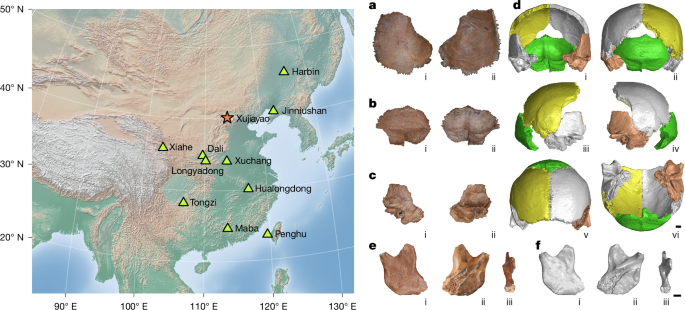
The Xujiayao assemblage, dated to around 199–138 ka through combined uranium series and electron-spin-resonance methods15, comprises 20 hominin cranial, mandibular and dental fossils excavated between 1976 and 1979 from a well-defined stratigraphic context in the Nihewan Basin, northern China16,17. This assemblage, recovered alongside abundant artifacts (dominated by scrapers and spheroids) and faunal remains, represents one of the most extensive collections among East Asian late Middle Pleistocene archaic Homo18,19 (Fig. 1 and Supplementary Text 1). Initial analyses identified a thick cranial vault, large cerebral fossa relativ