// NATURE NEWS — SPAZIO & SCIENZA
To heal sick cities, scientists and residents must work together
Sarah Wild is a freelance journalist in Canterbury, UK.
Search author on:
PubMed
Google Scholar
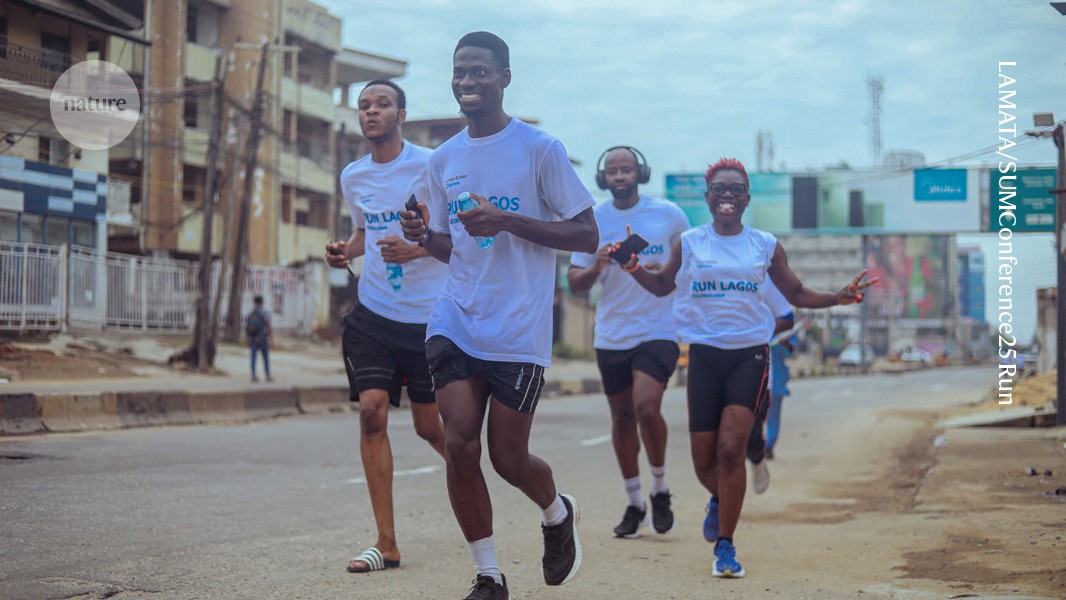
Tollulah Oni, right, running with teammates during an event at the International Conference on Sustainable Urban Mobility in Lagos, Nigeria, in 2025.Credit: LAMATA/The 2025 International Conference on Sustainable Urban Mobility Run
In 2016, public-health physician Tolullah Oni was jogging through the streets of Dakar when she saw someone doing push-ups in the middle of a busy roundabout. Cars were puffing fumes around him as the Sun baked down. As a physician, she knew that this had health implications.
More than half of the global population now lives in urban areas, but many cities are not conducive to human health and well-being. Oni, who is a researcher at University of Cambridge, UK, describes herself as an urban epidemiologist whose patients are cities. She works with colleagues around the world to diagnose and treat ‘sick’ cities with the goal of improving the health and quality of life of their inhabitants. This involves monitoring several variables, such as air quality and temperature, and their impact on the city’s residents. Those data can inform advocacy and interventions.
How I harness research to inform humanitarian relief efforts
Frustrated by a lack of infrastructure on the ground in such cities, and by the struggle to connect researchers and residents, she set up the non-profit organization UrbanBetter in 2019 to support her research and advocacy. By providing training on data collection and analysis, the organization helps citizens and local researchers to diagnose their own cities and to use that evidence to lobby for change. Its research arm, the UrbanBetter Academy, has a centre in Cambridge, and its civic arm, called Cityzens Hubs, operates in 11 cities in Africa, as well as in Bogotá and Bangkok.
Oni, who was born in Nigeria, identifies as African diaspora, which she classifies as a “sixth distinct region of the African continent”. Now based in the United Kingdom, she recognizes the friction that comes with trying to treat cities that she does not live in. Oni tells Nature how she wants to create lasting virtual infrastructure through UrbanBetter that channels the diaspora’s intellectual capital back into the continent and heals sick cities.
Cities can’t tell you that they’re sick, so you must bring the symptoms to light first. What are the lungs or air quality doing? What is happening in the green spaces? How is the city metabolizing energy? What is happening to its waste? If you don’t have the data, you don’t know whether the city is sick and in a lot of our cities, we’re not even measuring those things.
It is important that the people who are identifying the symptoms are on the ground in that city, rather than me, a professor, sitting thousands of kilometres away in Cambridge. People there are breathing the air and moving through the city. We have to equip local people with the skill set to diagnose a city. The diagnostic tests can be done by sensors and their data can be mapped.