// NATURE NEWS — SPAZIO & SCIENZA
Daily Briefing: Tiny doses of LSD seem to boost cognition
Search author on:
PubMed
Google Scholar
Hello Nature readers, would you like to get this Briefing in your inbox free every day? Sign up here.
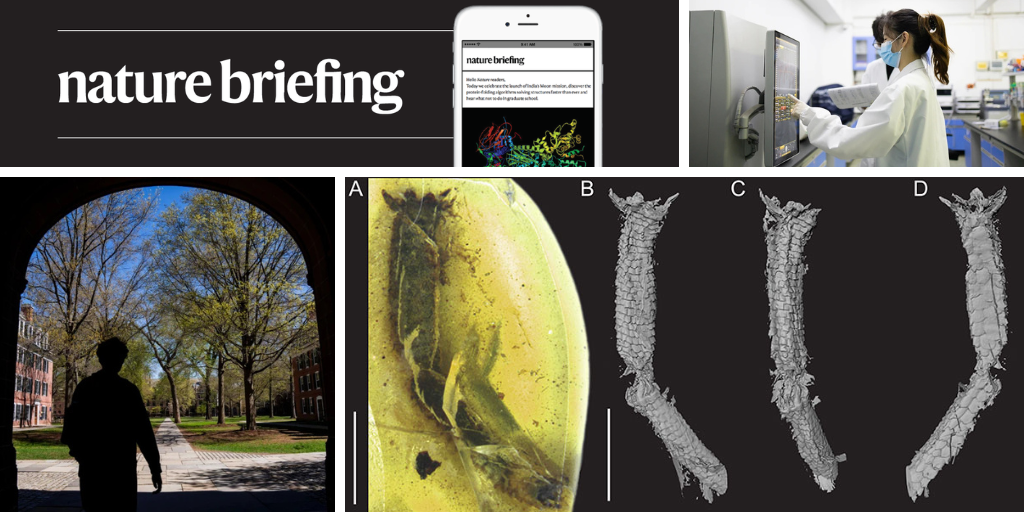
Researchers thought that the object inside a small piece of amber was a fragment of an ancient insect, until closer examination revealed the tell-tale scales of a lizard. The scale bar indicates 2.5 millimetres. (Dolev Fabrikant et al./Palaeontologia Electronica (CC BY-NC-SA 4.0))
A 99-million-year-old fossilized lizard tail seems to be the oldest-known evidence of the creatures’ ability to intentionally detach their appendages. Many modern-day lizards escape from predators by shedding and leaving behind their tails as a distraction, an ability called caudal autotomy. A 3D reconstruction of the fossilized tail revealed rosette-like wedges of muscle around a clean-cut bone — characteristics similar to those of modern shed tails. Researchers had long suspected that this behaviour was ancient in origin, but had found little evidence of it in known fossils.
The US government has launched an investigation into nine universities’ employment of international researchers. The probe’s purpose is to reduce “visa fraud”, according to vice-president JD Vance, who said that these universities are using too many J-1 visas — the main type used by international postdoctoral researchers in the United States. Critics say that the rationale for the investigation is flawed, that international postdocs play a crucial part in US laboratories and that the announcement is deepening the sense of unease felt by international scientists.
The National Natural Science Foundation of China (NSFC) has selected 44 young researchers as its first group to receive funding for up to 15 years, through one of the longest research grants available to scientists globally. Each will receive initial funding for five years, then be considered for a further five years after that time has elapsed, and so on. The grants come with no short-term targets, says Dou Xiankang, president of the NSFC. “We will assess only one thing: whether you are there in the laboratory.”
Climate scientists in the United States are facing a surge in public-records requests about their work linking emissions from fossil fuels to environmental harms. “Climate attribution is under attack,” says climate scientist Christopher Callahan. Requests of this kind are legal. But some researchers say the field has become a target because it plays a growing role in lawsuits against major industrial emitters. They say that the volume of requests seems intended to dissuade work on climate attribution, wastes time and public money, and could suppress healthy scientific debate.
The Japanese space agency, JAXA, yesterday launched a pioneering mission to grab and return a sample from one of Mars’s moons, Phobos. The Martian Moons eXploration (MMX) probe will drop a rover developed by the French space agency CNES and dubbed Idefix, after the little dog from the Asterix comics (Anglophones might know him as Dogmatix). Idefix weighs 25 kilograms on Earth, but will weigh only 12 grams — about the weight of one Earth pencil — when it lands on Phobos in August 2027.
Tiny doses of the psychedelic drug LSD seem to boost some elements of cognition — but only in women. In a small trial, women who took 15 micrograms of the drug focused for longer periods and responded faster to a stimulus than did those who were given a placebo. This trial alone can’t confirm that LSD was behind these benefits, but the signal “warrants further investigation”, says psychopharmacologist Mikkel Højlund. (Nature | 4 min read)
Reference: European College of Neuropsychopharmacology Congress Abstract (Source: Iva Totomanova et al.)