// NATURE NEWS — SPAZIO & SCIENZA
A first for CRISPR: powerful prime editing alters DNA directly in the human body
Heidi Ledford reports for Nature from Seattle, Washington.
Search author on:
PubMed
Google Scholar
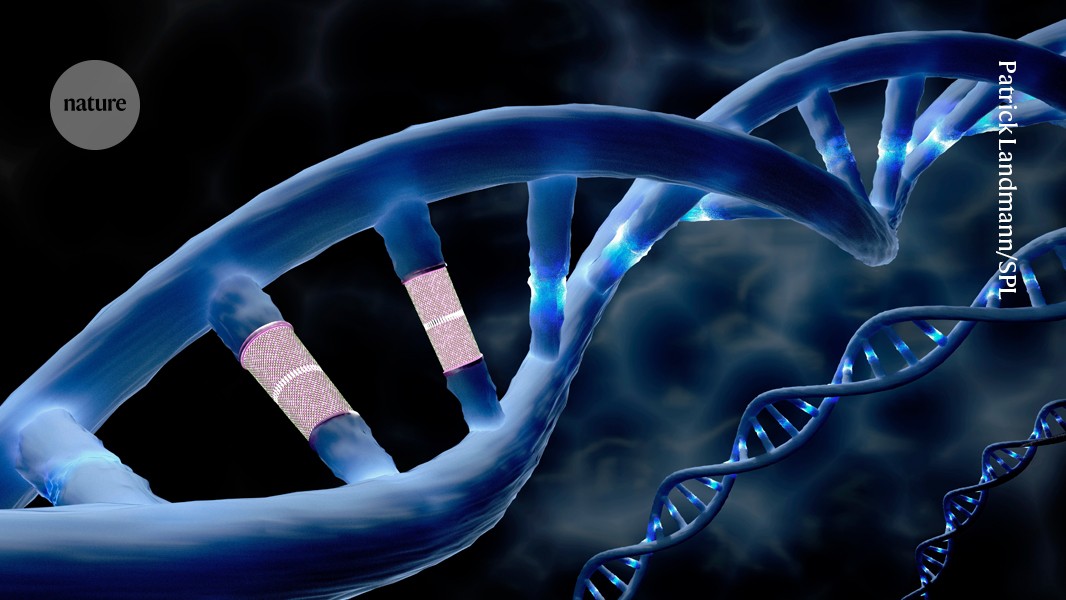
The method called prime editing can make fine-scale edits to DNA (artist’s illustration).Credit: Patrick Landmann/Science Photo Library
A powerful gene-editing technique has been used to edit DNA directly in a person’s body — the first known instance of such a treatment.
The milestone treatment is part of a clinical trial of prime editing, a technique that can alter DNA with more precision than standard CRISPR–Cas9 methods can. In this case, prime editing was used to treat a condition called Wilson disease by rewriting DNA in liver cells, to erase a mutation that prevents them from eliminating excess copper.
Prime Medicine, a biotechnology company in Cambridge, Massachusetts, announced that it had treated the first person in its trial earlier this month. It expects to announce the first results from the study next year.
Bigger than CRISPR? A guide to the latest genome editors
“I never dreamed that in my lifetime I would see this applied to my rare disease,” says Rhonda Rowland, president of the Wilson Disease Association in Atlanta, Georgia. “It’s going to be a really exciting year.”
In launching the trial, Prime Medicine joins a host of companies aiming to engineer cells directly in the body, rather than using the standard method of extracting a person’s cells, editing their DNA in a laboratory and then reinjecting the altered cells. Rewriting DNA in the body, or in vivo, is appealing because manufacturing and administering the treatment might be much cheaper and faster than making a bespoke therapy for each person from their own cells.
But in vivo approaches have their own challenges, says Krishanu Saha, a biomedical engineer at the University of Wisconsin–Madison. “It depends on what types of risks you’re willing to accept,” he says.