// NATURE NEWS — SPAZIO & SCIENZA
Brazil election: many scientists relieved as Lula wins surprise victory
Search author on:
PubMed
Google Scholar
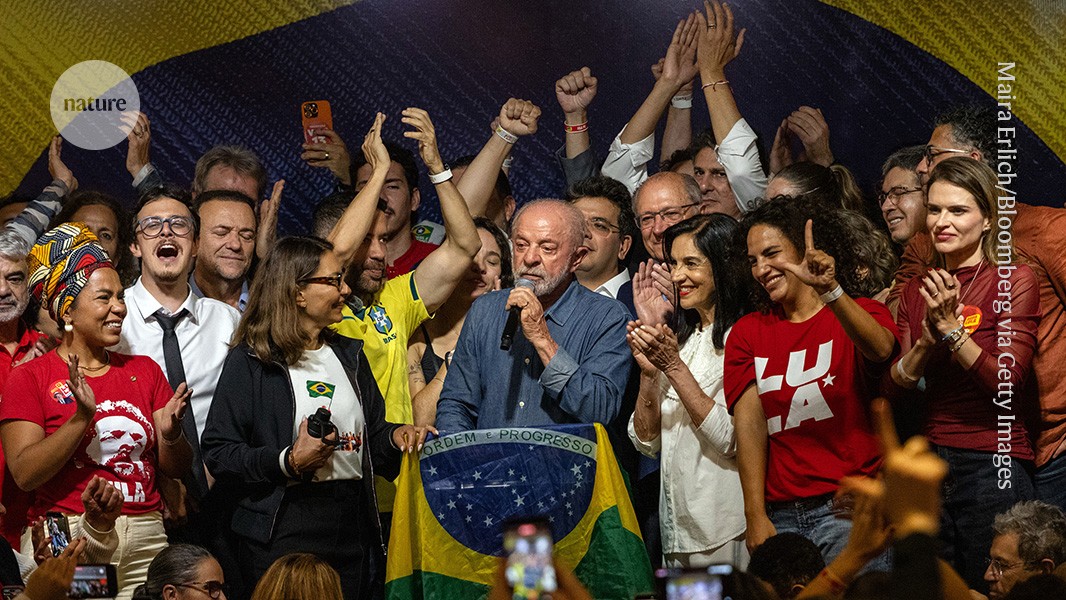
Luiz Inácio Lula da Silva celebrated on the evening of 25 October after coming from behind to win re-election as Brazil’s president.Credit: Maira Erlich/Bloomberg via Getty Images
Brazil’s President Luiz Inácio Lula da Silva won his bid for re-election on 25 October, to the relief of many scientists who feared for the future of Brazilian research if right-wing candidate Flávio Bolsonaro prevailed.
In recent weeks, some of Brazil’s leading scientific organizations, including the Brazilian Academy of Sciences in Rio de Janeiro, circulated an open letter endorsing Lula, a leftist former labour leader. It received more than 20,000 signatures. “It’s hard to express just how happy the scientific community and the Brazilian society is with Lula’s victory,” says Paulo Artaxo, a physicist at the University of São Paulo.
Science philanthropy is rising in Brazil ― upending a long tradition
Many worried that, if Bolsonaro were elected, he might slash support for Brazilian science and undermine it in the way that his father, Jair Bolsonaro, did. Jair was Brazil’s president from 2019 to 2023, and during that time, he cut science funding and expressed anti-science rhetoric during the COVID-19 pandemic, casting doubt on vaccines and promoting unproven treatments. The former president could not run for office again because he was sentenced to prison over a coup plot that he instigated after he lost his bid for re-election to Lula in 2022. He is currently serving the sentence at home because of health concerns.
It was a surprise victory yesterday for Lula, who won 51.8% of the vote compared with Flávio Bolsonaro’s 48.2%. During the first round of voting on 4 October, Lula finished behind Bolsonaro, but because neither candidate earned 50% of the total votes, a second round of voting was required. “It was very moving to watch this historic turnaround,” says Sidarta Ribeiro, a neuroscientist at the Federal University of Rio Grande do Norte in Natal.
Lula’s victory came at the end of a tumultuous election day. Shortly before the polls were meant to close, a justice in Brazil’s Supreme Court ordered them to remain open for an additional two hours. The move was requested by both Lula’s and Bolsonaro’s campaigns because of public transportation problems that made it difficult for voters to reach polling stations. In a short speech yesterday, Bolsonaro said he would not accept the results.
This will be Lula’s fourth term overall as president of Brazil, a record for the country. He initially led Brazil for two terms between 2003 and 2011. During those terms and his current term, which started in 2023, he championed the expansion of federal universities and efforts to make higher education accessible to a broad range of Brazilians, support that he has pledged to continue. He also launched a program in 2024 that brought back about 600 Brazilian scientists to the country from international institutions, where some had gone seeking improved funding and resources.
“Lula said very clearly in his victory speech that we need to strengthen federal universities and federal institutes and significantly improve how we prepare young people for a new world of [artificial intelligence] and robotics,” Ribeiro says.