// NATURE NEWS — SPAZIO & SCIENZA
Mysterious flickering brain signals could help to unlock secrets of consciousnes
Mariana Lenharo is a reporter for Nature in New York City.
Search author on:
PubMed
Google Scholar
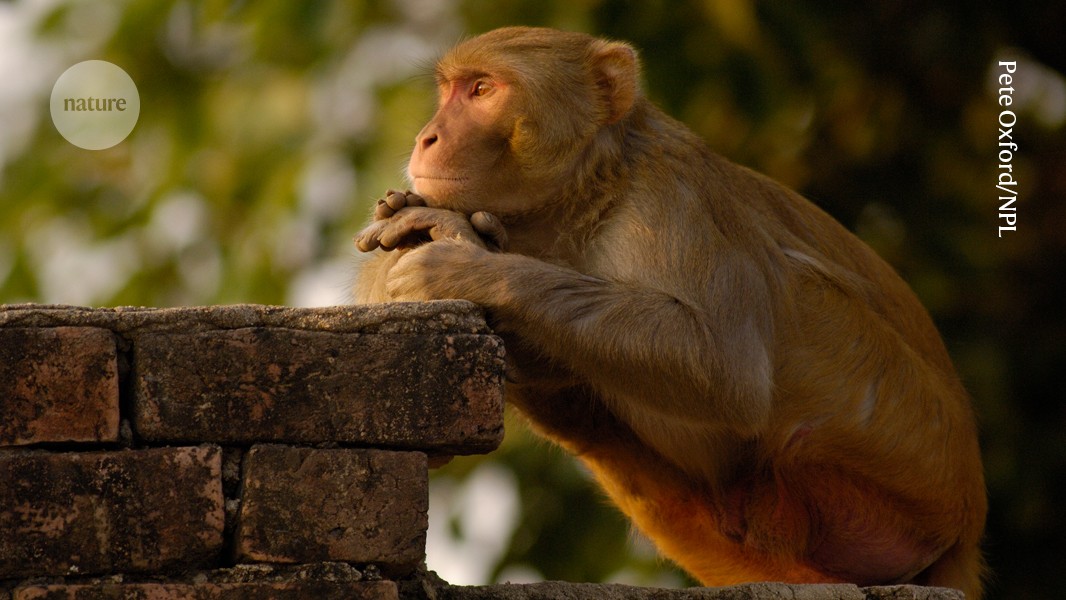
Monkey see: macaques’ brains strongly encode visual stimuli that are outside the animals’ awareness.Credit: Pete Oxford/Nature Picture Library
The reaction to neuroscientist Doris Tsao’s latest preprint, she says, has been “surreal”. Tsao, at the University of California, Berkeley, described the study on social media on 17 October. Ten days later, her summary has drawn more than two million views and 11,000 likes.
Posted on bioRxiv, the study1 probed the brains of macaques (Macaca mulatta) during a visual-perception experiment. Using only the monkeys’ neural activity, Tsao’s team managed to reconstruct with high fidelity not only images that the animals were consciously seeing, but also images that were in front of their eyes but escaped their awareness.
Three reasons why AI is not conscious and perhaps never will be
Previous studies in monkeys have detected neural activity in response to content they are not aware of, but only as weak signals. “It’s super surprising to find this strong signal that is not consciously perceived,” Tsao says. Even more unexpected to Tsao, the study showed that brain activity switched between patterns associated with conscious processing and those associated with unconscious processing several times per second.
The authors say that the findings, which have not yet been peer reviewed, could be a small step towards solving one of neuroscience’s biggest mysteries: how brains give rise to consciousness, or the subjective experience of being aware.
Scientists studying consciousness were intrigued by the research and praised its rigorous methods. But some pointed out that the social-media buzz might have been overblown. “It’s an interesting little firestorm of a paper,” says John Sakon, a cognitive neuroscientist at the University of California, Los Angeles. “But some of the findings were not totally unexpected.”
Imagine someone looking through binoculars that show a different image to each eye. The person would perceive only one image at a time, rather than a mix of the two. This phenomenon, known as binocular rivalry, is important for the study of consciousness, because it enables researchers to study what happens in the brain when an image enters someone’s consciousness.