// NATURE NEWS — SPAZIO & SCIENZA
A single-molecule spin–photon interface
Nature
volume 658, pages 1153–1159 (2026) Cite this article
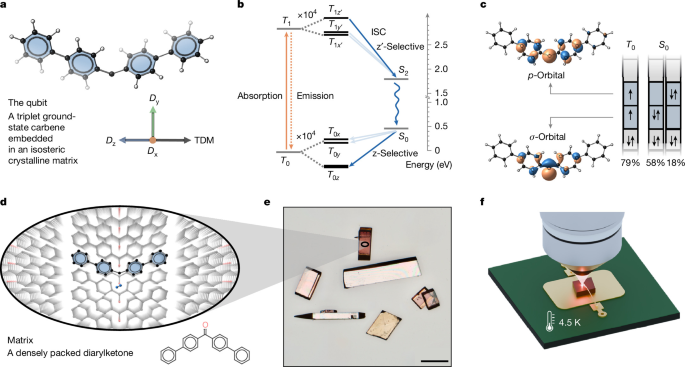
Optical interfaces that connect long-lived spin qubits to photons are a central requirement for quantum networking and distributed quantum information processing. At present, solid-state atomic defects are leading candidates because of their inherent spin and optical coherence1,2. Building on these advancements, synthetically tailored molecular systems represent a fundamental change in the field, using precise atomic control and consistent bottom-up assembly3,4. However, a molecular platform that concurrently satisfies the demands of a robust spin–photon interface—namely, the combination of bright fluorescence, high spectral stability and long ground-state spin lifetimes—has yet to be realized at the single-molecule level. Here we show that a triplet ground-state carbene molecule, embedded within a structurally matched host crystal, functions as a robust spin–photon interface with single-molecule addressability. The system exhibits narrow ZPLs, spectral stability over more than an hour, spin-selective optical transitions and single-molecule optically detected magnetic resonance. Coherent control yields millisecond-scale dynamical-decoupling coherence and tens-of-milliseconds spin relaxation at a temperature of 4.5 K. These results establish molecular qubits as a viable platform for single-emitter quantum optics5,6 while preserving the advantages of bottom-up chemical design7 and processable materials8,9,10.
At present, colour centres in wide-bandgap semiconductors, spearheaded by the nitrogen-vacancy centre in diamond, have driven landmark achievements from loophole-free Bell inequality tests11 and multi-node quantum networks12 to fault-tolerant quantum error correction13. For practical applications at room temperature, the nitrogen-vacancy centre remains an exceptional benchmark for solid-state spin lifetimes. However, semiconductor-based solid-state systems fundamentally suffer from extraneous electron defects and charge traps inherent to the host crystal, such as diamond14,15 or silicon carbide16,17. These fluctuating charge environments cause substantial optical spectral diffusion, degrading the spectral stability of the emitter. Although inversion-symmetric defects, such as the silicon-vacancy centre in diamond, offer better optical stability by mitigating these charge noise effects18,19, they instead face phonon-limited spin coherence times. By contrast, molecular crystals are assembled by weak intermolecular interactions rather than continuous covalent networks4 and are known to lack the extraneous electron defects and charge traps of semiconductor materials20 (for a quantitative comparison of different spin–photon interfaces; see Supplementary Information section VIII). Leveraging this pristine environment, alongside precise atomic control and consistent bottom-up assembly3, optical spin readout has been successfully demonstrated across a variety of molecular platforms. Originally, the first demonstration of optically detected magnetic resonance (ODMR) in single molecules was performed on pentacene, which possesses an excited-state triplet electron spin21. Progressing towards ground-state electron spin systems, in more recent works, organometallic chromium(IV) complexes22 have proven to be a versatile platform, with the ability to tune spin properties by chemically changing the qubit or the matrix7. Moreover, molecular rare-earth complexes leverage the inherently narrow optical linewidths of rare-earth ions within molecular crystal environments23, facilitating the optical readout of both electron24 and nuclear spin states25. Meanwhile, purely organic qubits such as diradicals26,27,28 and carbenes29 offer a distinct advantage; the absence of heavy atoms minimizes spin–orbit coupling, leading to significantly extended spin lifetimes and cyclical, coherent optical transitions. To date, however, experimental progress on molecular qubi