// NATURE NEWS — SPAZIO & SCIENZA
Alzheimer’s disease genetics converges on microglial and neuronal dysregulation
Nature
(2026) Cite this article
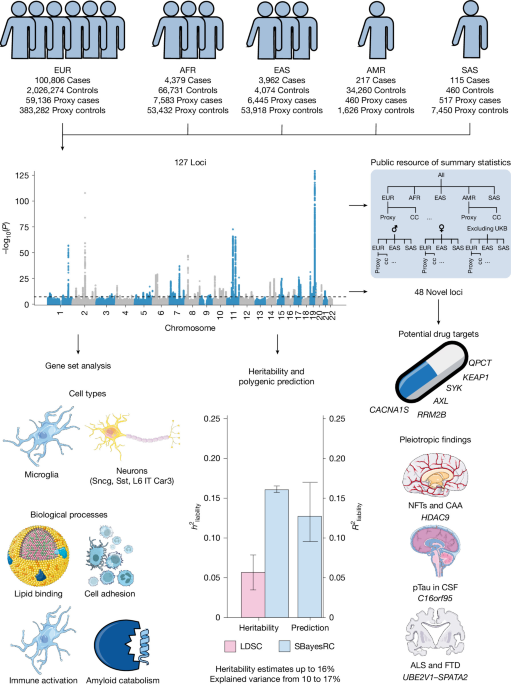
Alzheimer’s disease (AD) is the most common cause of dementia, with global case numbers projected to reach 153 million in 20501. AD is highly heritable, with twin-based heritability estimates of 60–80%2. Although 1,200 causal loci are predicted to exist for AD3, approximately 80 loci have been associated with AD in two recent studies4,5. Low single-nucleotide polymorphism (SNP)-based heritability estimates have prompted the suggestion that little further common-variant risk remains to be found6. Here we analysed data from 109,479 cases, 74,141 proxy cases, 2,131,799 controls and 499,708 proxy controls from diverse ancestries, identifying 118 loci in a multi-ancestry analysis and 9 additional loci in ancestry-specific analyses, 48 of which are new. We identified new AD risk genes, prioritized potential drug targets, and found that genes upregulated in microglia and downregulated in neurons in cases compared with controls were enriched for AD-associated genetic risk. Moreover, we improved polygenic prediction and estimated a SNP heritability of 16%, nearly threefold higher than previous estimates. Together, our findings show that the common-variant contribution to AD has been substantially underestimated, and reveal new molecular and cellular mechanisms as well as specific targets for future drug development research.
AD is the most common cause of dementia, affecting tens of millions of people worldwide and projected to more than double by 20501. Current disease-modifying treatments for AD typically target only one aspect of its pathology: amyloid-β aggregates. However, these have shown limited efficacy in alleviating symptoms7. Further insight into disease aetiology may highlight other mechanisms that could lead to more effective drugs. Given the large twin-based heritability of AD (\({h}_{{\rm{twin}}}^{2}\) = 60–80%)2, genetic studies can provide valuable insights into its underlying biological mechanisms. Moreover, polygenic scores (PGSs) may improve clinical risk prediction models and help to identify individuals for early intervention before the onset of neurodegenerative processes.
Recent genome-wide association studies (GWAS) of AD have successfully identified approximately 80 risk loci, highlighting the central role of microglia and suggesting immune function, amyloid catabolism and lipid function as important biological processes4,5. Despite these discoveries, the PGSs generated from these studies have had limited predictive performance4, and liability-scale summary-statistics-based heritability (\({h}_{{\rm{SNP,liab}}}^{2}\)) estimates have been low (approximately 5%)8. This discrepancy has prompted the suggestion that there may be little additional genetic risk that can be identified with GWAS6 beyond the strongest genetic risk factor for AD: APOE. Others, however, have proposed that approximately 1,200 causal loci are expected to influence genetic risk for AD3. To reconcile these differences, larger studies leveraging improved, well-calibrated methodologies will be critical. Such efforts may yield more accurate heritability estimates, enhance the predictive power of PGSs and, importantly, uncover additional risk genes informing disease mechanisms. Moreover, including individuals of non-European (EUR) ancestry can further improve PGS prediction in underrepresented populations.
Here we report a large multi-ancestry GWAS of AD, encompassing a total of 109,479 cases, 74,141 proxy cases, 2,131,799 controls and 499,708 proxy controls. Proxy cases are genotyped individuals who reported that their parents had AD (Methods). Using this sample, we identified 118 loci in a multi-ancestry analysis and 9 additional loci in ancestry-specific analyses, 48 of which are new. We estimated a \({h}_{{\rm{SNP,liab}}}^{2}\) of 16% and improved the out-of-sample prediction. We also found enrichment in microglia and in neuronal cell types, and highlighted relevant biological p