// NATURE NEWS — SPAZIO & SCIENZA
Diet at disease onset determines tissue inflammatory memory
Nature
(2026) Cite this article
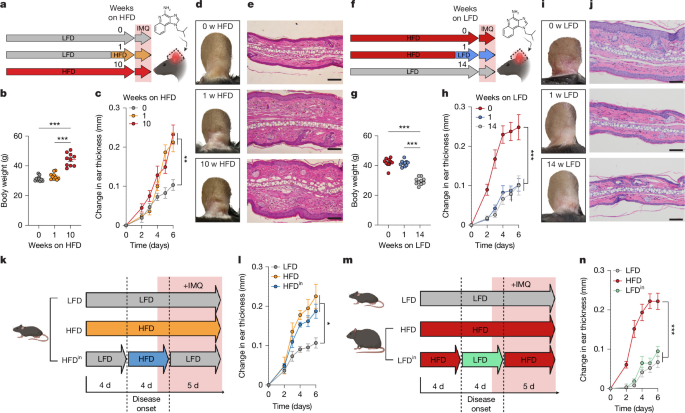
Obesity, which is often associated with prolonged exposure to an obesogenic diet, substantially alters immunity1,2,3,4,5,6,7, but whether brief dietary changes shape acute inflammatory responses and long-term tissue memory remains unclear. Here we show that transient high-fat diet (HFD) exposure at the onset of acute type 17 skin inflammation exacerbates disease in lean mice to levels comparable to those associated with chronic obesity. This effect is restricted to a discrete 4-day peri-initiation window; HFD outside this window has no impact, whereas switching obese mice to a low-fat diet (LFD) during a similar window fully blunts disease amplification. Mechanistically, HFD rapidly recruits neutrophils into the skin, and neutrophils in challenged skin express high levels of Nlrp3 (ref. 8) and Il1b. Neutrophil depletion, genetic Nlrp3 deficiency and pharmacological NLRP3 inhibition each blunt the HFD-induced inflammatory amplification. These findings nominate a neutrophil–NLRP3–IL-1β axis that licences pathogenic IL-1R1+CD4+ T helper type 17 (TH17) cells9,10. After recovery, a chromatin-poised tissue-resident memory T cell population persists. Consequently, mice exposed to HFD at disease onset develop exaggerated inflammation upon recurrence, despite recovery and maintenance on LFD. Transient HFD similarly amplifies lung TH17 inflammation through neutrophil- and IL-1R1-dependent mechanisms. Together, these findings show that dietary state during a narrow temporal window can durably reprogram disease trajectory, suggesting that short-lived physiological states may become embedded in local immune memory11 when they coincide with tissue inflammation.
Obesity alters immune function across multiple contexts, including infection, autoimmunity and cancer7,12,13,14,15,16,17. This effect is especially pronounced in the skin, where obesity exacerbates inflammation and complicates therapeutic responses6,18. Although chronic obesity and weeks to months of obesogenic diet exposure are known to remodel cutaneous immunity, these longer interventions also produce cumulative metabolic, endocrine, microbial and tissue remodelling across multiple organ systems7. It remains unclear whether comparatively brief, days-scale dietary exposures, before such systemic remodelling is established, can acutely modify triggered inflammatory responses and durably imprint long-term tissue inflammatory memory. Experimental models of acute type 17 skin inflammation provide an opportunity to examine these effects, as psoriasis, a type 17 inflammatory disease tightly linked to obesity4,15, has also been associated with dietary patterns and other nutritional exposures19,20,21. We therefore examined whether transient dietary state could bidirectionally modify the response to a synchronized inflammatory trigger, such that HFD amplifies inflammation in lean mice whereas LFD restrains inflammation in obese mice, and whether this acute dietary window could alter subsequent tissue inflammatory recall.
To distinguish the impact of diet itself from the consequences of established obesity, we used topical imiquimod (IMQ) challenge as a synchronized model of acute type 17 skin inflammation in which age-matched mice were fed either a short-term (1 week) or long-term (10 weeks) HFD (60% kcal from fat), or a low-fat (control) diet (LFD; 10% kcal from fat), before topical IMQ challenge22 (Fig. 1a). Mice remained on their assigned diets throughout IMQ challenge. Measurements of serum cytokine levels before application of IMQ did not reveal significant differences between the three groups (Extended Data Fig. 1a), although we did observe modestly increased numbers of TH17 cells and γδ T cells in the skin of mice fed a short- and long-term HFD, relative to the mice fed LFD (Extended Data Fig. 1b–d). Both short- and long-term HFD also reduced glucose tolerance, although these effects were more pronounced in obese mice th