// KOTAKU — GAMING
BioWare’s Knights Of The Old Republic Entirely Changed My Understanding Of What Games Could Be
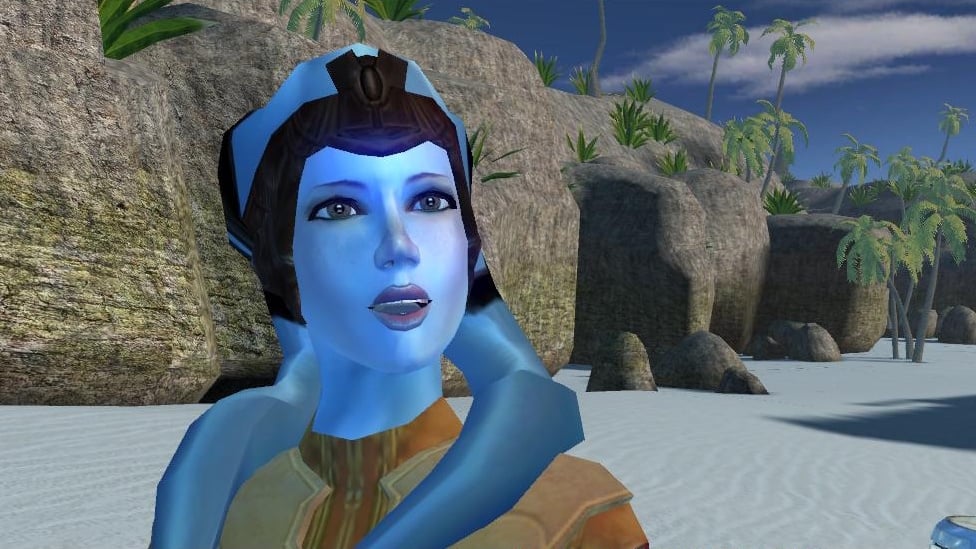
As the grim echo of the demise of BioWare continues to reverberate around the world, I cannot stop thinking about what a pivotal impact the company’s extraordinary run of games had on me. The Mass Effect trilogy was obviously stunning, Dragon Age: Origins means more to me than your Lord of the Rings, and Jade Empire holds a special place for me despite being forgotten by so many. But it wasn’t any of these, or the legendary Baldur’s Gate or its sequel, that hit me the hardest. It was Star Wars: Knights of the Old Republic.
There are games I’ve played and adored and replayed, and they exist in my head as just that: wonderful games. Then there are a rare few that exceed this, that occupy a bigger, more important place, that feel far more like crucial memories, deeply influential vacations from my past that shaped me, and stay with me forever. Among them I count The Longest Journey, Firewatch, and 2003’s Knights of the Old Republic.
I think about characters like Bastila and Mission and HK-47 as friends from a previous era of my life, rather than companions in a video game. KotOR burst its banks and flooded over my life. I can completely understand why for many there’s a stronger connection to the wonderful characters from the Mass Effect series (and I concede that Garrus and Mordin have the same presence in my life), but it’s KotOR that shines brightest for me. That unique relationship between Zaalbar and Mission, the moments when HK accidentally allowed the tiniest crack in his sneering veneer, the way Bastila rolled her eyes at me so frequently, it all feels so large.
Star Wars missed me as a kid. I was pretty much the ideal age, born in the year the first movie was released, and surrounded by its all-consuming popularity in the early ’80s. But it did something very wrong: A group of friends wanted to watch A New Hope one Thursday afternoon when I was seven years old instead of playing outside, and I wanted to play outside. So I hated it. And like a dumb kid, that was enough for me to decide I just didn’t like Star Wars overall. It wasn’t until 1997 that I even watched the three films properly, when I bought the trilogy boxset in widescreen on VHS ahead of Lucas’s remastered 20th anniversary editions replacing them entirely. So it was only six years before KotOR originally came out that I finally accepted they were a bunch of fun movies, and yet I still stubbornly held on to a determination that they weren’t that good.
KotOR, meanwhile, affected me immediately. After the slightly game-y opening tutorial on the Endar Spire, your arrival on the Sith-occupied planet of Taris, set 4,000 years before the events Lucas had created, was so utterly extraordinary. It was the first time I’d experienced so much possibility in a game, so many different things to do and directions to go in and ways to approach each situation I encountered.
There was an underclass who were being denied vital medicine in this city, and I could intervene and stop the elites from hoarding a curing serum and make it available to the less fortunate, supporting a secret clinic that was aiding the poorest, but I wasn’t doing this because it was the one and only pre-determined endpoint of the quest. Rather, I had chosen to do this. but rather the choices I made. I remember this well because in 2009 I wrote a trilogy of pieces for Eurogamer for which I replayed the whole game, but this time only making the most evil decisions possible. It turns out you can blackmail the doctor running the free clinic for the poor and steal all his medpacks, and that’s just the beginning. The serum that quickly cures the disease that’s spreading throughout the undercity can be easily synthesized and distributed widely by stealing it from the Sith, but this time I instead went out of my way to prevent that and sold the sample to a Hutt crime lord who would only use it to exploit people.
As I went about this larger quest, I was able to ruin so many people’s lives in so many unneces