// SPACE.COM — SPAZIO & SCIENZA
James Webb Space Telescope uncovers new clues about the origins of 'interstellar invader' comet 3I/ATLAS
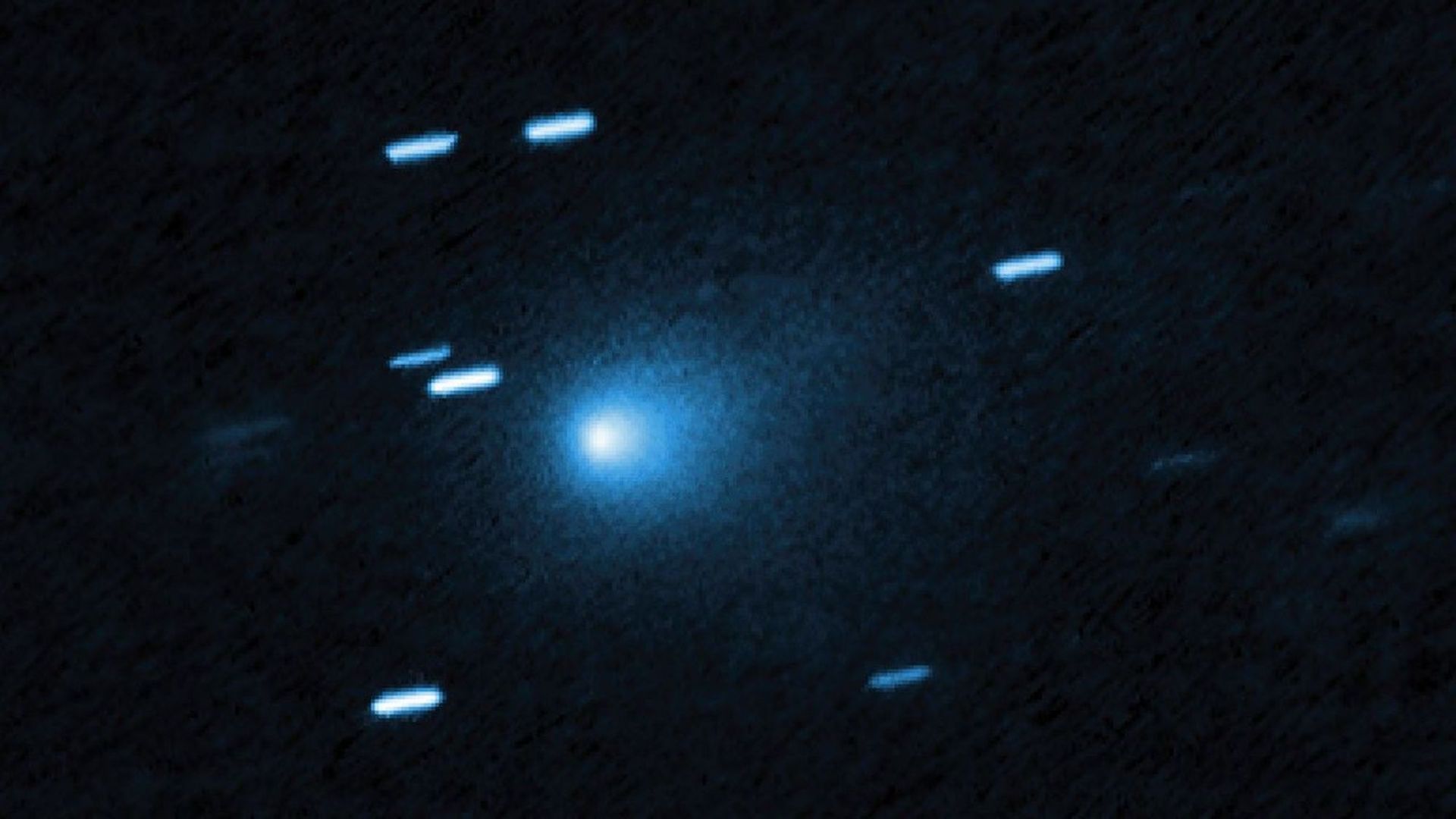
The findings are another clue towards understanding the origins of 3I/ATLAS and the planet-forming conditions around other stars.
When you purchase through links on our site, we may earn an affiliate commission. Here’s how it works.
Using the James Webb Space Telescope (JWST), scientists have found that the interstellar comet 3I/ATLAS was built from tiny grains of ice mixed with dust that are quite different from the solar system’s comets.
These ice grains do, however, bear striking similarities to some icy bodies located at the edge of the solar system, beyond the orbit of Neptune, so-called trans-Neptunian objects (TNOs).
3I/ATLAS was discovered entering the solar system in the summer of 2025. It was only the third object found entering the solar system from farther afield in the Milky Way after 1I/'Oumuamua, seen in 2017, and 2I/Borisov, detected in 2019. This meant the interstellar comet offered a rare chance to glimpse the conditions under which such bodies form in other star systems. Thus, the JWST was quickly on the trail of 3I/ATLAS.
"We designed [JWST] to be ready the moment an active interstellar comet was found and to follow it over time," Martin Cordiner of NASA’s Goddard Space Flight Center and the Catholic University of America said in a statement.
Cordiner leads the JWST program to study objects such as 3I/ATLAS, and he is a co-author on a new research paper describing some of the findings.
Researchers know that 3I/ATLAS wasn't born in the solar system, but nobody knows around which star 3I/ATLAS formed. What scientists are more sure of is the fact that this interstellar comet was produced within a planet-forming disk of gas and dust around a young star, possibly as long ago as 10 to 12 billion years. That's over twice the age of our solar system. It was then ejected from its home system somehow and left to wander interstellar space before encountering our solar system.
Like the familiar comets in our solar system, 3I/ATLAS is composed of grains of ice less than a micron – a millionth of a meter – in size. When the surface of the comet is warmed by the sun, gas erupts outwards, carrying ice grains into the cloud of ice and dust surrounding the comet, its coma, and its tail, where JWST can detect them.
When viewed spectroscopically, the water-ice in comets native to our solar system creates a strong absorption line in a comet’s spectrum at a wavelength of three microns, as well as less-prominent absorption lines at 1.5 and two microns.