// NASA BREAKING NEWS — SPAZIO & SCIENZA
NASA Shares Plans to Accelerate Artemis, Return to Moon
In an update on Oct. 23, NASA Administrator Jared Isaacman and other agency leaders shared the agency’s path to returning Americans to the lunar surface in 2028.
Agency leadership provided updates on the previously announced acceleration plans for the Artemis program, advancing toward the agency’s Artemis III test flight in 2027 and Artemis IV Moon landing mission in 2028. Building on the priorities announced at Ignition earlier this year, NASA leadership shared the agency’s significant progress across its missions, working with industry partners to test critical capabilities, reduce risk, and build toward a sustained American presence on the Moon.
“This is a very energized NASA, and these updates are only a small part of that story. We are bringing extreme focus to the mission to ensure delivery of world-changing outcomes as quickly, safely, affordably, and successfully as possible,” said Isaacman. “NASA is driving outcomes to make Moon missions a reality, and we’re not waiting for others to bring their plans to us — the campaign must move with urgency as strategic competitors pursue a permanent presence beyond Earth.”
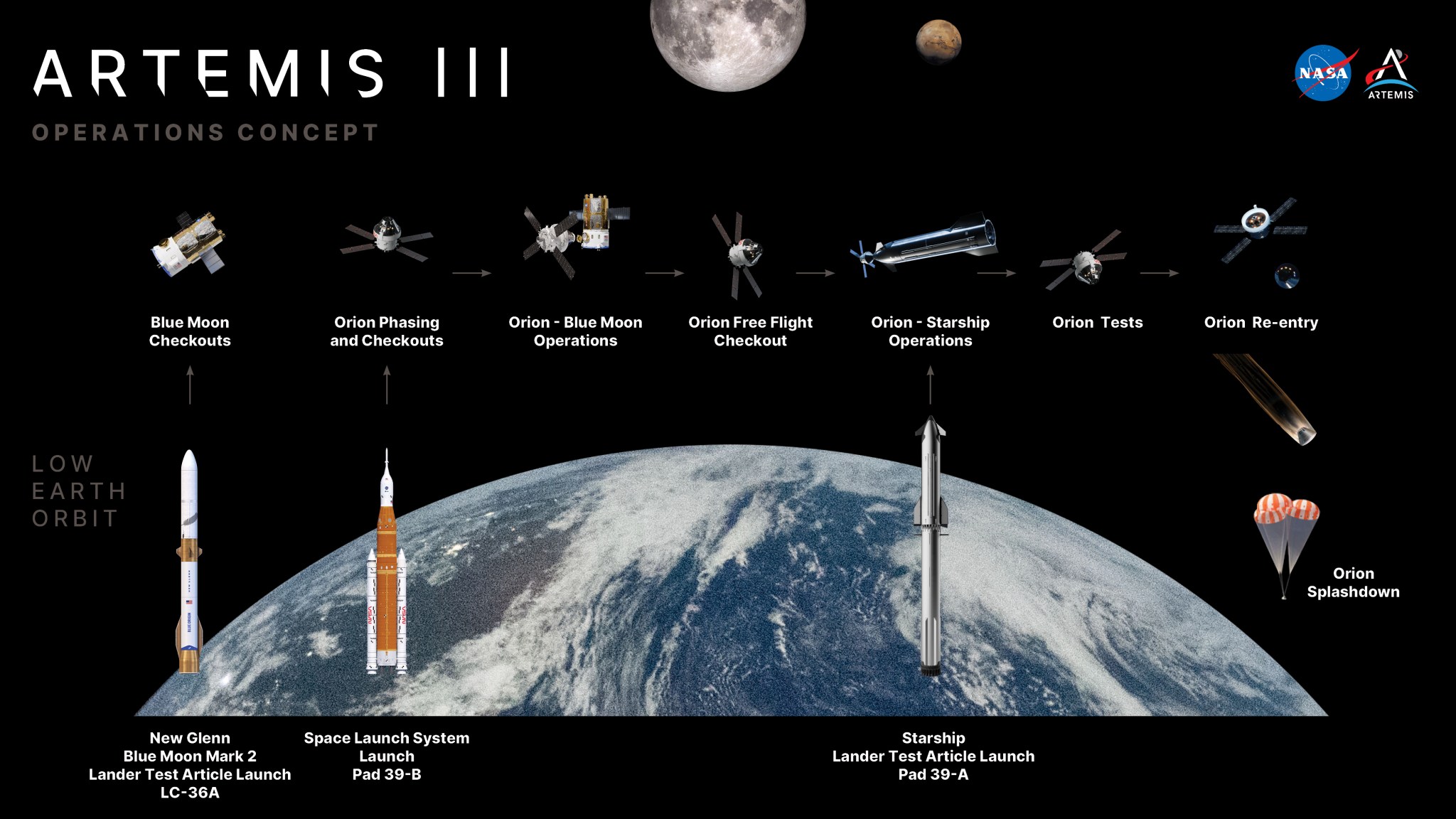
The agency shared details of the Artemis III mission, which will test rendezvous, docking, and operations between NASA’s Orion spacecraft and lunar lander test vehicles from SpaceX and Blue Origin in Earth orbit. Four astronauts will fly aboard Orion, launched on NASA’s SLS (Space Launch System) rocket, for a planned 14-day mission in Earth orbit to reduce risk ahead of the Artemis IV moon landing mission.
The Artemis III mission will unfold in sequence: Blue Origin will launch a Blue Moon lander test article into Earth orbit, SLS will launch Orion and its crew, docking with the Blue Moon lander test article, then SpaceX will launch a Version 3 Starship lander test article while Orion will undock from Blue Moon and dock with Starship.
The Oct. 23 updates follow other recent updates about the Artemis missions. Hardware for Artemis III is on track, with processing timelines sharply reduced by about half. NASA also redesigned, built, and tested a critical fuel-line component in-house in five months, at roughly a tenth of the cost of an earlier outside-vendor estimate.
“NASA should be expected to do this kind of work, and we have some of the best technical knowledge in the world on rocket hardware and operations to do it,” said Jeremy Parsons, the agency’s Artemis program manager. “It’s an example of how we are rebuilding our core competencies and developing centers of excellence in technical functions instead of continuing to outsource expertise.”
For the agency’s Artemis IV mission in 2028, astronauts will launch aboard Orion on the SLS rocket from NASA’s Kennedy Space Center in Florida. NASA is working with SpaceX and Blue Origin to develop lunar landers to carry those astronauts to the Moon’s surface. Both companies have redesigned their approaches to simplify the missions and make them more efficient and flexible as compared to previous mission designs.
SpaceX’s Starship will refuel in Earth orbit, rendezvous with Orion, and then carry the spacecraft toward the Moon. Blue Origin’s approach involves transfer stages in Earth orbit to push its Blue Moon Mark 2 lander toward the Moon, where it will meet Orion in a closer lunar orbit before descending to the surface.
Both SpaceX and Blue Origin are targeting to be able to support a crewed lunar landing in 2028.