// SPACE.COM — SPAZIO & SCIENZA
Mars isn't dead — recent volcanic activity reveals it's just sleeping
When you purchase through links on our site, we may earn an affiliate commission. Here’s how it works.
Scientists have long suspected that Mars is geologically "dead," but new spacecraft observations suggest the Red Planet's volcanoes are merely sleeping.
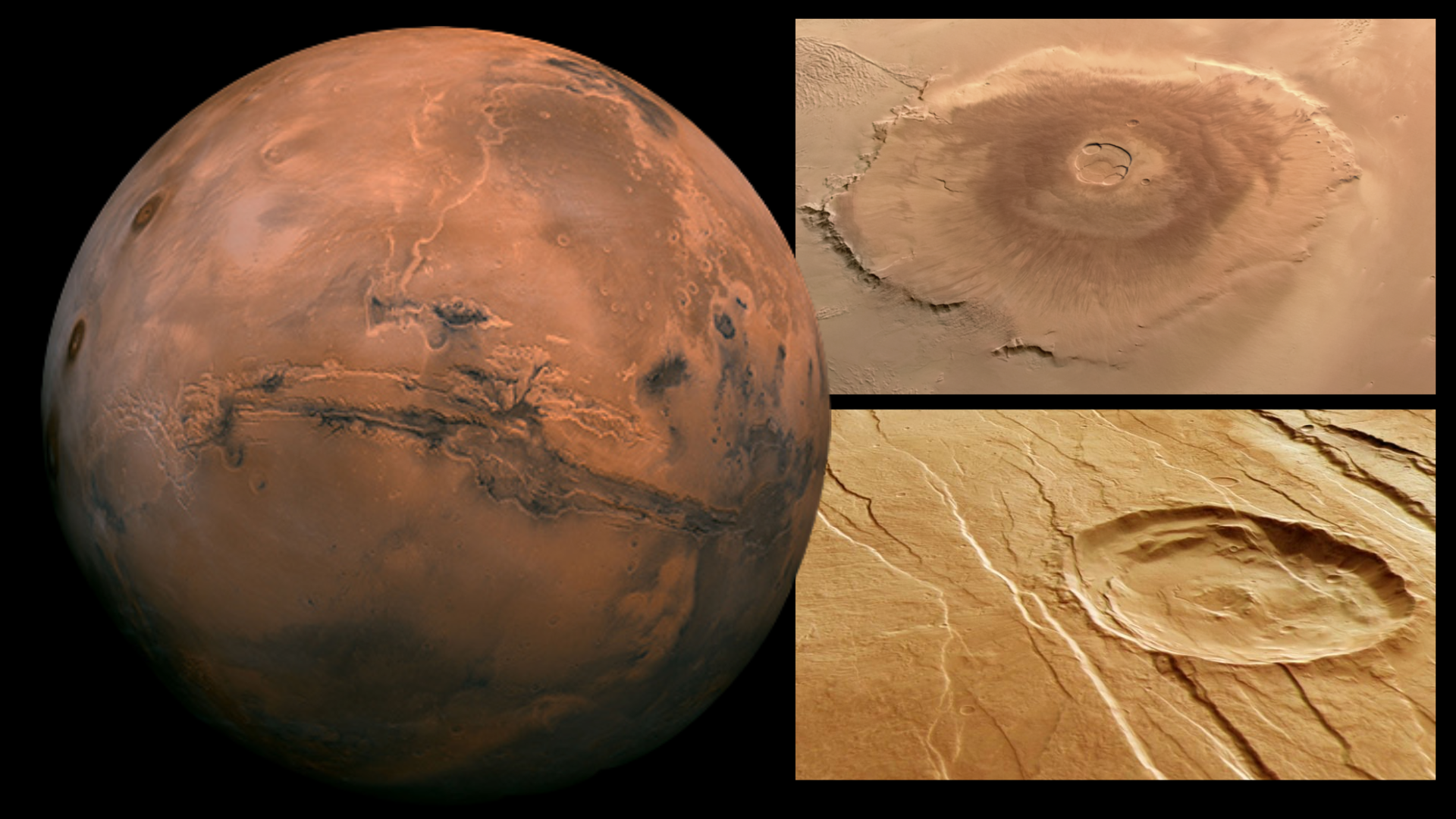
That means that Olympus Mons, the extinct Martian volcano that at around 16 miles (26 kilometers) above the surrounding Martian plains is the largest mountain in the solar system, may in fact be a slumbering giant.
The observations were made with the European Space Agency (ESA) mission ExoMars Trace Gas Orbiter (TGO) as it studied volcanic fissures along the Alba Mons region of the Red Planet. Alba Mons is in the Tharsis region of Mars, the same area that is home to Olympus Mons. While the latter is the tallest volcano in the solar system, at 374 miles (600 km) across, about the size of Arizona, the Alba Mons region is the largest volcano when considering surface area.
TGO detected gas containing hydrogen chloride making its way to the surface of Mars through the Alba Mons fissures. The same gas is commonly found escaping from magmatic vents on Earth, with the compound coming from hot magma beneath the surface. Detecting it on Mars is a sign of dormant Martian volcanism.
Orbital imagery had previously shown some volcanoes appear to have been active within the last few million years, and seismometers have detected the rumbling of "marsquakes," both implying the Red Planet is volcanically active. However, eruptions and lava flows have been conspicuous by their absence.
"Our findings suggest that Mars has retained enough internal heat to support volcanic activity until recently, and possibly still does," team co-leader and scientist at the Space Research Centre of the Polish Academy of Sciences, Daniel Mège, said in a statement sent to Space.com via email. "The TGO was able to find the smoking gun. It was like looking for a needle in a haystack."
Mège and colleagues were first alerted to something strange happening on Mars when they noticed spikes of hydrogen chloride during Martian summer and on the northern hemisphere of the Red Planet. That is both a time and place at which hydrogen chloride shouldn't be detected.
The gas usually peaks in the northern hemisphere during winter on Mars, disappearing in the summer. This variation is connected to the water and dust cycle on Mars. An exception to the rule occurs over volcanic fissures on the flanks of the Alba Mons volcano, in early summer.
The TGO followed up on this by detecting fresh and narrow fissures, in some cases hundreds of feet long, in the Alba Mons region. A clear sign of volcanism.