// NATURE NEWS — SPAZIO & SCIENZA
Accelerating commercialization and deployment of indoor photovoltaics
Nature
volume 659, pages 49–57 (2026) Cite this article
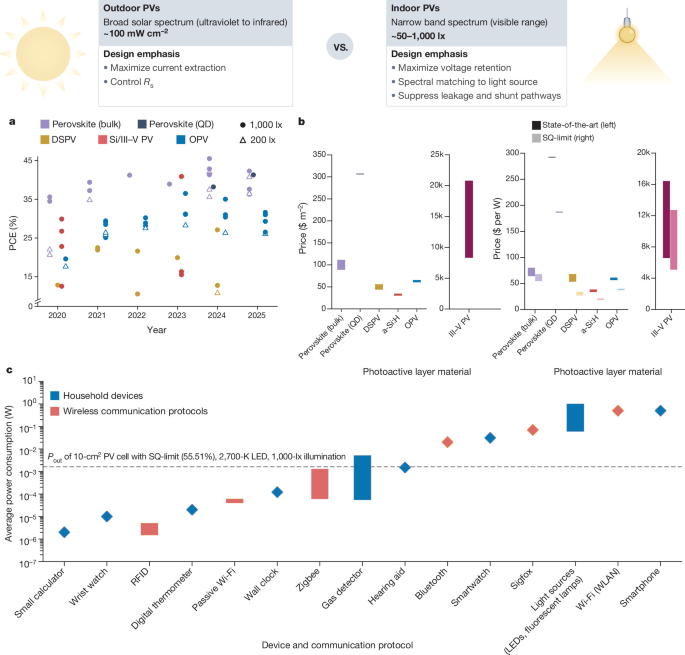
The growing reliance on distributed electronics, such as Internet of Things (IoT) nodes, smart-home devices and portable consumer products, has intensified demand for indoor energy-harvesting technologies that reduce battery replacement and servicing. Consequently, indoor photovoltaics (PVs) have advanced rapidly; however, translating state-of-the-art cells into deployable products requires design principles that reflect real indoor conditions. Here recent progress in perovskite (bulk and quantum dot), organic, amorphous-silicon, III–V and dye-sensitized PVs is examined to identify bottlenecks that arise under low-light conditions and during scale-up. This Review highlights how low-light operation favours wide-bandgap absorbers and reduced non-radiative voltage losses while reshaping module design: lower series-resistance (RS) penalties permit wider subcells and fewer interconnections, increasing geometric fill factor, whereas shunt and leakage pathways consume more of the weak photocurrent. Measurement practices for credible cross-technology benchmarking are discussed, emphasizing the transparent reporting of spectra, illuminance/irradiance, stabilization and uncertainty. Finally, the relationship between device performance and manufacturability and product integration is considered, including power-management requirements and chemical/regulatory constraints (for example, restricted substances and end-of-life handling). These guidelines provide a practical framework for evaluating indoor PVs on the basis of delivered and retained power and for accelerating the transition from laboratory-scale demonstrations to reliable, visually adaptable products for the built environment.
This is a preview of subscription content, access via your institution
Access Nature and 54 other Nature Portfolio journals
Get Nature+, our best-value online-access subscription
Prices may be subject to local taxes which are calculated during checkout
Perkel, J. M. The Internet of Things comes to the lab. Nature 542, 125–126 (2017).
Article
PubMed
Google Scholar
Portilla, L. et al. Wirelessly powered large-area electronics for the Internet of Things. Nat. Electron. 6, 10–17 (2023).
Sanchez, L. et al. SmartSantander: IoT experimentation over a smart city testbed. Comput. Netw. 61, 217–238 (2014).