// NATURE NEWS — SPAZIO & SCIENZA
In vivo CAR-T double knockout screen maps synergistic antitumour gene pairs
Nature
(2026) Cite this article
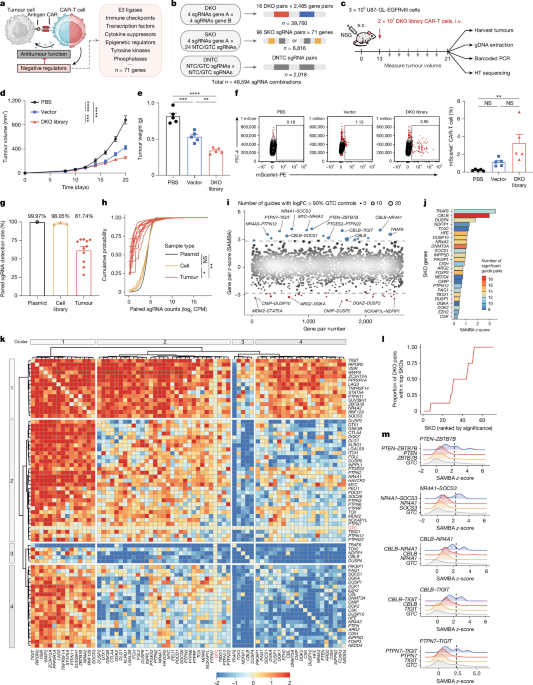
Chimeric antigen receptor (CAR)-T cell therapy has transformed the treatment of haematological malignancies, but its efficacy remains limited by multiple negative regulatory mechanisms intrinsic to T cells1,2,3,4. Here we perform a high-throughput in vivo CAR-T double-knockout (DKO) CRISPR screen, and identify multiple DKO gene pairs that are both effective and synergistic. The top pair, NR4A1–SOCS3 DKO, has multiple favourable immunological features. Whole-transcriptome profiling and in vivo single-cell RNA sequencing reveal that NR4A1–SOCS3 DKO specifically upregulates metabolic pathways in CAR-T cells, which show significantly higher metabolic fitness and mitochondrial activity. NR4A1–SOCS3 DKO CAR-T cells and T cells exhibit exceptionally potent antitumour efficacy and long-term tumour control across different tumour models without compromising safety features. NR4A1–SOCS3 DKO outperforms several benchmark single-gene and dual-gene modifications in T cells and CAR-T cells5,6,7,8,9. These data demonstrate high-throughput in vivo CAR-T DKO screening for rapid discovery of combination targets, and establish NR4A1–SOCS3 as a promising pair of intracellular checkpoints to engineer high-performance CAR-T therapies against cancer.
This is a preview of subscription content, access via your institution
Access Nature and 54 other Nature Portfolio journals
Get Nature+, our best-value online-access subscription
Prices may be subject to local taxes which are calculated during checkout
All data generated or analysed in this study are included in this article, its Supplementary Information, source data files and Supplementary Datasets, or are available through public repositories. Raw and processed high-throughput sequencing data generated in this study, including CRISPR screen sequencing, targeted amplicon sequencing, bulk RNA-seq, single-cell RNA-seq, CUT&RUN and WGS data, have been deposited in the Gene Expression Omnibus under the accession numbers GSE272887 and GSE335215, and the Sequence Read Archive under the accession number PRJNA1477126. Source data and statistical information for non-high-throughput experiments, including flow cytometry, protein analyses, imaging analyses and other molecular or cellular assays, are provided with this paper as source data files. Processed results and relevant quantifications from high-throughput experiments are provided in the Supplementary Datasets. The following publicly available reference datasets and resources were used in this study: the human reference genome GRCh38 Gencode v44 for bulk RNA-seq analyses; the human reference genome GRCh38 Gencode v37 for single-cell RNA-seq analyses; the human reference genome GRCh38 Gencode v47 and ENCODE blacklist regions for GRCh38 for WGS analyses; the Molecular Signatures Database (MSigDB v7.4); and the ProjecTILs single-cell T cell atlas dataset. Parental cell lines are available from the commercial sources listed in the Methods and Supplementary Information. Engineered cell lines, plasmids and other research materials generated in this study are available from the corresponding author on reasonable request and completion of any required material transfer agreements. Source data are provided with this paper.
Custom code used for data analysis and figure generation in this study is available at GitHub (https://github.com/Prenauer/DKO-CAR-T).
Li, Y.-R., Zhu, Y., Halladay, T. & Yang, L. In vivo CAR engineering for immunotherapy. Nat. Rev. Immunol. 25, 725–744 (2025).
Article
PubMed
Google Scholar